My friend Nancy died recently. Tom is her husband. This was my homily for them at Nancy’s funeral.
It is good to be here with you today. I flew down from Boston on Thursday just for this occasion. I’m not making a big deal out of it. I’m certain that a lot of us took a plane just to be here today, and from a lot farther away than Boston. I’m nearly certain that all of us came here in a car today, and that some of us spent all day yesterday, and maybe even the day before—in those cars—driving just to get here.
Some of us, like Tom, didn’t have to sit for long in the car to get here. It’s maybe an 8 or 9 minutes drive from here to Wormley Creek. But I bet it felt like it took forever. Journeys of the heart can be that way. We love someone for almost our whole life. They get sick. We care for them year after year. How can we expect goodbye to take only an hour or two?
I don’t imagine that any of us walked here today. That would have taken too long, I guess. Think about all the things we did just to get here, and how we probably would have had to do without them, if we’d wanted to walk to get here. We would have had to skip breakfast, go without the flowers, the plate of cookies for after the service, settle for wearing a pair of shorts and a tee shirt instead of a finely pressed suit, if we’d wanted to walk here today.
No question, it took some doing to get us all here today. And I know that’s not really saying much because after all, Nancy died. And she loved us, and we loved her, and we miss her now very much, and Tom and the family have been so gracious to gather us all here today. Fly, drive, walk, who wouldn’t have found their way here?
So please forgive me, I don’t mean to sound insensitive or anything, like I’m rushing us out of here. No one would be more pleased than Nancy to have us linger here for a while. But still, I’ve got to ask: does anyone have any good plans for after the service? Anyone going to see a movie? Hitting the beach? Hitting the bar? Grabbing a bite to eat somewhere? Just going to bed early? Come on, you can’t honestly tell me that you haven’t thought about what comes next.
There’s a Bible story in which we’re told that on a day just like today, at a moment just like now, two people decided to go for a walk. Now of course it makes you wonder, what kind of day was that exactly? Well we know it was a day on which a few women had gone to the cemetery in the early morning to visit Jesus’s grave. Three days ago they watched in shock and horror as their friend was put to death on trumped up charges of trying to overthrow the world. (All these women knew was that Jesus had always been kind to them, and they guessed it had overthrown their world.) And now he was dead and no one had given them a chance to return the kindness or to give him a funeral.
So taking along some spices with which to anoint his body they went with the darkness to find where Jesus had been buried. But when they got there, the grave was empty. Confused and sad by this, they just stood there. When quite suddenly two men in dazzling clothes appeared, asking them, “Why are you looking for Jesus here? Don’t you remember what he told you, that this is exactly how it all would go? That he would be put to death and then 3 days later rise again. He is not here.”
What to do, what to do next…
The women rush off to find some of the disciples to give them the report. Not to tell them, “We have seen Jesus, he’s alive again!” because they haven’t, and they don’t know. But just to tell them, this is what we’ve heard. And naturally some of the disciples believe the report and some of them don’t.
Now I don’t know what you would have done next, had you been there to hear the report, but we’re told that a couple of them went out for a walk. Maybe they just needed to clear their heads, or clear the air with God. It had been a full day so far—up early, off to the cemetery, no Jesus there. Whatever the case, it is while they’re out for a stroll, talking about all that has happened, that Jesus himself meets up with them. Except they don’t know it’s Jesus.
I used to read this story and say, well I just flat out don’t believe that. I mean, how can you not recognize a guy you just saw three days ago? Did three days in the ground really change Jesus up that much? Maybe the sun was in their eyes at that moment and they couldn’t see clearly. Maybe? How do you not see the stars on a starry night?
There’s something I’m beginning to understand, though, about grief and sadness. Grief and sadness have the power to fundamentally change the way we see each other.
Last May, around Memorial Day, I went with an elderly woman to the cemetery to lay some flowers on her husband’s tombstone. While there she walked me around a bit, pointing out the various family members who were also buried there. When you walk around a cemetery you notice things—names, dates, who lived to be old and who died young. Anyway, at one point we were standing in front of a tombstone that read, Harry Simon Cox, Beloved of the Lord.
“That was my uncle, my mother’s youngest brother,” Mabel said (Mabel was the woman’s name).
“That’s a lovely thing to have said about him,” I remarked. “Harry must have been well loved.”
“Actually,” she said without pause, “no one could stand him; not a friend in the world. But my mother had Beloved of the Lord put on his tombstone because that’s how she wanted him to be remembered.”
I think it’s worth pointing out that despite all the efforts to convince the two travelers out walking on the road that day that Jesus was not dead but alive and well, Jesus himself couldn’t convince them. Oh he tried. He tried quoting scripture to them, and lots of it. Starting way back in the Old Testament with Moses and all the prophets, he told them the whole story about himself. But all they had to say was, yes, we had hoped. He tried reminding them of the promise that he would rise again on the third day and that today is the third day. But still all they had to say was, we had hoped. He pointed out the women and what they said about the two men in dazzling clothes, but they called it a vision, a daydream, and said only, we had hoped.
What to do, what to do next…
“So they came near the village to which they were going,” the story goes, “and Jesus walked ahead as if he was going on. But they urged him strongly, saying, “Stay with us. The day is almost over.” So he went in and stayed with them. And while they were sitting at the table, he took bread, blessed and broke it, and gave it to them. Then their eyes were opened, and they recognized him.”
The English poet William Blake once wrote, “I sought my soul, but my soul I could not see; I sought my God, but my God eluded me; I sought my neighbor, and I found all three.”
You see, if it’s proof of resurrection that we want—proof of heaven and of life after death—than we’ll have to do more than read the Bible. We’ll have to do more than to say we believe in Jesus. We’ll have to invite a perfect stranger into our home, sit down to a meal with them, and take the bread that they have to offer us.
 I want to tell you just one story, and then I’ll be done.
For having spent six years in this very place with Nancy, I knew Nancy mostly because we traveled together to Honduras on several occasions. Nancy absolutely loved Honduras. It would be hard to say what it was exactly that Nancy loved. Most of the people that I know who travel on mission trips to third world countries go because they can. They can heal, they can teach, they can build, they can give in ways that not even the people who live there can. And this is neither here nor there, but I believe Nancy went to Honduras more for the getting. To get her eyes opened. To get her heart opened. To get an education in people and things that are far and away different. Then to get to say, here, here is the kingdom of God.
To look at Nancy walk around Honduras you’d think she was one of the relatives, just back in town for a family reunion. I remember being there with her in 2010. We were traveling with a group of about 20 from this church. We’d been in the country all week, staying in a remote village. As usual Nancy spent her days in the medical clinic working out her compassion, while I worked construction, helping to build new homes for families who had never known more than stick walls and bugs crawling on their children at night. But mostly I carried water and tried not to break anything. On the last day of our trip, while most of the team toured some of the local sites, Nancy and I, along with one other team member, Pat, decided to venture back to the community of El Bonete, where the three of us had worked two years earlier. 
El Bonete is a hillside community located just outside the tourist town of Copan. To get to El Bonete you have to walk over a river on a rickety bridge, hike half a mile through some dense cornfields, past a couple abandoned tobacco barns, and then crisscross your way along dirt paths, climbing the whole way. Fortunately for us that day, on the other side of the bridge was a rusty old pick-up truck and a couple young boys who thought it cool to give 3 gringos a ride. Nancy climbed into the front while Pat and I hopped in the back and held on for what I was sure were going to be my final moments on earth.
At the top of the hill we got out in front of the village school. About 6 children—dirty, shoeless, and smiling—came scampering out to see what all the commotion was about. In her divine wisdom, and I think scheming all along for a moment just like this, Nancy had packed about 25 sheets of stickers in her backpack. She handed them out and the children began to decorate each other and us from head-to-toe.
This went on until Pat, Nancy, and I said, adios, we have to go. Pat and I said we wanted to hike the distance across the village, about a mile, to see some of the houses we had worked on two years earlier. Nancy said, “Go for it, but I’m going to find a spot just to sit. Come and find me when you get back.” Pat and I weren’t so sure we trusted the idea of Nancy hanging out alone in some cornfield. When we did come back though, about 45 minutes later, we found Nancy sitting in a lawn chair on a porch, shucking corn.
“Whose house is this?” I asked her.
She was peeling off another husk. “I don’t know.”
“What are you going to do with that corn?”
“I’m going to give it to the people who live here.”
“But you don’t even know who they are.
And Nancy said, “What does that have to do with anything?”
She got up and started down the hill. “Do you want to take the truck?” I asked her. “No, we’ll walk.
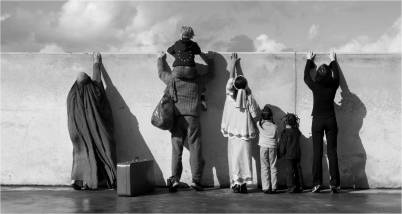
We hiked back down past the tobacco barns and over the rickety bridge. On the other side we had a decision to make, walk a long flat path out to a main road or hop a rock wall and be right we needed to be to meet up with the rest of our group. It was Nancy who decided on the rock wall. It was about 4 ½ feet tall. We decided Pat would climb up onto the wall and then reach back to pull Nancy up. When Nancy went to put here foot against the wall, however, she couldn’t make it happen. I was just waiting my turn behind her when she looked back at me and said, “You’re going to have to push.” I suggested that maybe I could give her ten fingers, or grab her by one ankle and a knee and give her a boost. We could count off and on 5 away she’d go. But she said no, that’s not going to work. (Years later Nancy would come to recall it as the moment she realized the ALS was setting in.)
So I squared off behind her.
“Are you sure we shouldn’t try the ten-fingers trick? Maybe we could take the long way around after all?”
She just smiled, assured me that Tom would never have to find out, and counted down 3…2…1. I pressed up against her bottom side, she laughed, we all heaved and hoed, and up the wall she went.
I got to speak with Nancy on the phone the morning she died. She said she wanted to talk, but I knew she couldn’t and I didn’t know what to say. So I read her a few lines from the ever-eloquent Anne Lamott. “Courage is fear that has said it prayers,” Lamott writes. And then she goes on to talk about what happened in the weeks after the end of WWII, in the refugee camps for orphans and dislocated kids. Of course the children couldn’t sleep at night with all that fear and terror filling their heads. “But the grown-ups discovered that after you fed them, if you gave them each a piece of bread just to hold, they would drift off. It was holding bread—a sign that there was more to eat if they were still hungry. This was bread to hold, to remind them and connect them to the great truth that morning would come, that there were grown-ups who cared and were watching over them, that there would be more food when they awoke.”
In the church when we break bread and pass it around we call it sacrament—mystery, celebration—the body of Christ given for you and you and you and you that no one should be left out, for here, here is the kingdom of God! We call it a mystery because it makes no earthly sense that God would love us all so equally and graciously. We call it a celebration because God does.

In her own way, Nancy was the perfect sacrament. She passed herself around this world, letting just about everyone take a piece of her. It was tough at times. Nancy didn’t like to quit and at the end of the day there wasn’t always much of her left to go around. She knew it, and Tom knew it, but Tom, you were her holding bread. No, you didn’t get to take all those trips you were hoping to take in retirement. You did, however, get her to where she needed to go. In these last years especially you did your part to carry her with dignity and I believe the very thought of you got her through the nights. You were her holding bread. Bless you for that.
I’m sorry I didn’t bring any bread for you, or for any of us, today. But I did bring some corn. And I wonder what would happen if we started passing it around. Do you think there would be enough for everyone to get a nibble? Enough to hold each of us over through our grief, to get us over the wall and through the night? For the love of God, Nancy and Jesus would say there is, there always is.

 PleaseGrace