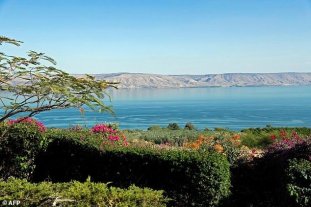
 Do you remember what it was like to be on that hillside? It was a perfect spot—that hillside—not unlike the spot you may be sitting in now. Rather quiet and a little removed from everything.
The plot goes that Jesus and his disciples had just come off a long week of ministry. They were due for some R&R and had to take a boat across a lake to get to that hillside. Poor Jesus, he had recently received news that his cousin John the Baptist had been executed by King Herod for the crime of publically calling out the king. It had been discovered that Herod was having an affair. John said it was shameful and abusive, even for a king. So, sad, grieving, and emotionally spent, a little time under the sun on a lonely hillside would be just the ticket for Jesus and his disciples.
Except when Jesus and his disciples get to that hillside, there are 5,000 or more people gathered about waiting for them. And the people are hungry. Not hungry for a mid-morning snack. I mean, forced to pick scraps-from-the-trash-for-days hungry. And Jesus, turning to the disciples—tired, worn down and looking for the closest exit—tells them, “You give these people something to eat.” But how could they? All they had on hand were a few loaves of bread and a couple fish, and they were pretty hungry themselves. Feed the crowd and they’ll never go away. Don’t feed them and…they’ll never go away.
 In such situations, is there really a good next move?
And Jesus says, “Give me what you got.” And taking their bits of bread and fish he blesses it and breaks it and gives it to the disciples, as if to say, this much you can always do.
The crowds had more than their fill that day on the hillside. So much bread and fish that there were basketfuls of leftovers. And with that Jesus wastes no time in telling the disciples to get back in the boat. Maybe Jesus knew that if they stuck around for too long, the crowds would start asking for dessert. Maybe he just wanted to finish what he’d started that day. He had set out to find a quiet spot to recharge and dang if he wasn’t going to find one still. Whatever the case, immediately he makes the disciples set sail for the other side of the lake while he hangs back to break up the crowd. This is, perhaps, the most curious feature of the story, that having arrived on the hillside with the disciples, Jesus does not leave with them.
For just before getting to the hillside, we’re told that Jesus and the disciples have gotten into a boat and sailed across the lake in an effort to get away from the crowd. So why does Jesus now stay with the crowd?
You know, crowds can be exciting, if they’re not wanting something, and did you ever meet a crowd that didn’t want something? With Jesus there was always a crowd, and so he must also have known that crowds can be dangerous. You can get accustomed to the popularity, to people always looking to you to lead them, to heal them…to feed them. It can feel good to be needed, until one night you’re lying in bed and you can’t fall asleep on your own.
There’s a story that almost every candidate for president tells about being out on the campaign trail. Crisscrossing the country, the days are long and the nights are short. If you make 3 stops a day, you make 4. If you make 4, you make 5. On and off planes and podiums all day long. Glad-handing everyone, trying not to make too much of this person or too little of that one. It can be exhausting, and invariably, at some point, when the candidate has lost track of where they are and which number stop it is, they will turn to some aide or to their spouse and ask the question: who am I, and why is what we are doing here important again?
And maybe this is why Jesus put the disciples back in the boat and shoved them off back across the lake without him. He’d brought them across the lake and up the hill to get away from the crowds, but the crowds found them anyway. And though at first the disciples didn’t want the bother of the crowds, when they discovered they could give the crowd what the crowd wanted, and that the crowd kind of liked them for it, they suddenly didn’t mind the crowd so much. I can imagine one disciple saying to another disciple, “Look at them all. They’re huge. And they love us.” And that was Jesus’s cue to get them the hell out of there.
Meanwhile, Jesus, who is seen as having no attachment to crowds, hikes himself further up the hillside to be alone and to pray, which is exactly what you would do if you needed to remember who you are and what’s important—you’d talk to your father. So, with no crowds to drown out the silence Jesus just sits and listens. The disciples on the other hand are now out in the middle of the lake rowing against the wind and getting nowhere. Despite the fact that they are fishermen and that they were feeling pretty good about themselves when they got into the boat, that was 9 or 10 hours ago. Now they’re overtired, underfed, and they’re not sure their sleepy eyes aren’t playing tricks on them when they see a figure walking (walking!) across the top of the water and coming towards them. In fear they cry out, it’s a ghost! But Jesus assures them, “Take heart, it is I; do not be afraid.”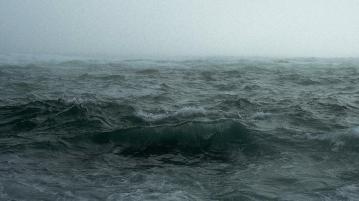
Take heart, it is I; do not be afraid.
What we are talking about, really, is power and who holds it. We have seen—once again—a great deal made of power recently. Our newsfeeds and Facebook pages have been overwhelmed with images of power, of power against power, of some people carrying torches, wearing the white hoods of the KKK, and chanting White Lives Matter and “We will not be replaced by the Jews,” and others carrying signs that read No to White Supremacy and Black Lives Matter, while clergy link arms in the street. There has been death in Charlottesville by those who would drive a car into a crowd and come bearing torches. I have no answer to racism except to say that this is not power, at least not by any definition offered us by Jesus.
I think it’s worth noting that when the disciples first see someone going by their boat, walking on water, they are afraid without knowing what they are afraid of. Is it Jesus? Is it a ghost?
“Take heart, it is I; do not be afraid.”
Take heart.
If we would overcome our fear and be truly powerful, we must dig deep within ourselves and consider the way of our hearts. We must be honest about the prejudices and sins that live there, that we put there, that we allowed others to put there. Because I am a person accustomed to privilege, which means that even if I tell myself I am accustomed to equality, I still have a long-ways to go.
How long?
“Lord, if it’s you, tell me to come to you on the water,” says just one (just one?) disciple.
If the first step towards being powerful is to take heart, the second step must be to get out of the boat. To move towards the thing that you fear. To believe that the thing isn’t a thing at all, but a person. Not an enemy. Not a ghost. Not an object to be handled. But a person, with a heart just like me and you.
Of course, we can’t see one another if we are wearing hoods. This is the thing that I am beginning to understand about people who carry torches and wear hoods over their heads. They’re not afraid of seeing you. They’re afraid of you seeing them. Sure, they don’t mind being seeing as part of the crowd, because as the old saying goes, there’s strength in numbers. But not always. Sometimes the crowd is only a cover-up, a protection for our fear and cowardice.
My reader, I would give you a little power to carry with you today, to carry into this world where terrible and beautiful things can happen. It’s not my power. It belongs to the one who walks openly upon the waves, who dares to be seen. The one who hangs naked upon a cross, dying to save the very ones who put him there. The One who says, “Take heart, it is I; do not be afraid.”
 PleaseGrace