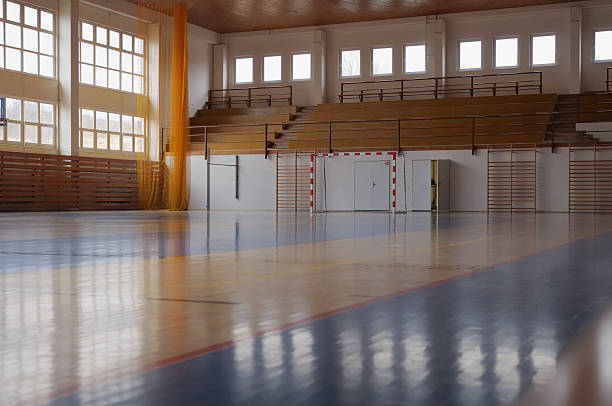
The Two Fans

Last Friday night, I went with my son to a local high school basketball game.    At half-time, as the two teams left the court to go to their respective locker rooms, two boys, who had been sitting on the front bleachers during the game, got up and began dribbling and passing a ball between them on the sidelines.  Judging from their size, they couldn’t have been  more than 10.  One of them had on a home team sweatshirt, and one was wearing visitor’s colors.  Maybe they knew each other, maybe they didn’t.  You could tell they really wanted to head out onto that empty court and run around, and maybe even shoot the ball, but they didn’t know if this was an okay thing for them to do.  So, they just stood there on the sidelines passing the ball.   

Now if you’ve ever been to a high school basketball game then you know, there is almost always a section of the bleachers that is unofficially reserved for high school students.  This section is loud, very loud.  No one ever sits down in it, and no parent, or self-respecting adult, would ever try to join it.  In this particular gymnasium, there was just one section like this, and so the home team’s and the visiting team’s high schools were sitting together, or pretty close to it.

Anyway, you need to know this so you can understand the power of what happened next.  A couple high schoolers came down out of the bleachers and started playing ball with the two boys on the sidelines, and before we knew it, there was a half-time game going on.  The two young boys were now out in the middle of the empty court, in full-view of a packed gymnasium.  The high schoolers weren’t taking any shots; they were just dishing the ball to the two boys so they could take all the shots.  For anyone with eyes to see, it wasn’t hard to see what was going on. 

Every now and then one of the boys would hesitate to take a shot—because they were way down here and the basket was way up there—and the high schoolers would move them in a little closer and gently encourage them to give it their best heave-ho.  At first, no baskets were dropping in, but then one shot would go in and you’d hear the whole student section of the gym let out a cheer.  Then another shot, and another cheer.  When a shot went up, there was a pause while everyone held their breath, and then, if the shot missed, a collective “aww,”  followed by someone in the student section yelling out, “Try again.” 

You could see that none of the adults were really even paying attention to what was going on.  No one over 18 seemed to notice that well over 100 high school students, some wearing green, some wearing blue, were now rooting for the same team of two 10-year old boys.

Meanwhile, the scoreboard was ticking down the time until half-time was over.  The two teams had returned to the court, but still, only the two boys were playing basketball, while now, the players themselves stood around cheering for this new kind of game. 

Eventually the buzzer went off and the two boys had to leave the court.  But in the 4th quarter, when the game was rather close, the student section got rather rowdy.  I looked over at one point to see who was making all the racket, and there they were, right in the middle of the pack—two 10-year old boys.


The Good Book tells a story about a woman who had been crippled for 18 years, an entire childhood.  Hunched over, all she ever did was look down.  Even if she could have made herself stand up straight, no one would have noticed her anyway.  To most, she was a beggar, rapping at the car window for spare change.  No one seemed to understand that by 8 a.m. everyday, she had already put in more work than most were going to put in all week.  For just to get out of bed again was an act of courage for her.  And she didn’t get weekends off. 

Then, on a Sunday of all days, when the world is supposed to be resting but instead is given to complaining about how little rest they are getting, one—just one—merciful soul sees this woman.  In this, he does what no one else up until now has been willing to do, and it changes everything.  The woman stands up!  Those who are trying to rest, of course, complain that she is disturbing them.  They say that tomorrow would have been the more appropriate day for healing.  “Couldn’t this wait?”  But the Merciful Soul knows that “wait” almost always means “never.” 


The truth is, there is nothing so difficult as going out into a world that doesn’t see you as human.  To convince ourselves that we belong even if unnoticed.  Just as there is nothing so easy as giving a couple 10-year olds a respectful place to stand in the section where no self-respecting adult would ever dare to join in.  

A Few Good Words

Last Tuesday morning, I took one of my new neighbors from Afghanistan, along with his 10 year-old son, to get a COVID test. The boy was having dental surgery on Thursday, and he first needed to get a COVID test.  At 8:30 I pulled up to their apartment and out they came.  Now neither the father nor the son speak much English, and I don’t speak any Pashto, so I knew it was going to be a quiet ride. 

“How are you?”

“Good,” the father said.

“Good.  So…you’re good.  That’s…good.”

This went on for about 10 minutes.  I don’t think the father minded the quiet.  If there’s one thing I’ve come to learn from my new neighbors it’s that the only thing refugees expect from anyone is a safe, quiet world to live and raise their kids in.  Which is all any of us should expect.  But the quiet was killing me.  So I began to point out everything in sight like I was giving a vocabulary lesson.  “Radio.  Snow.  Snow plow.  Exit.  Sign.  Says Providence.”  The father would smile, but never say anything.

After the COVID test, we dropped his son off at school, which left just the two of us in the car together.  Pulling up the long driveway to his apartment building, it was still very quiet, when suddenly I heard him say, “Exit.  Snow plow.  Providence.  Radio.” 

“Hey!  That’s very good.”  I didn’t think he’d really been listening to anything I’d been saying.

“You…my…teacher.  Thank you.” Well, I don’t know about that, I thought to myself.

Pulling up to his front door, he said to me, “Come in.  Eat.” 

I had given him Exit, Snow plow, Providence, and Radio. Which isn’t nothing. But he was giving me bread and a seat at the table.  “You…my…teacher.  Thank you,” I said to him.

Saint Francis of Assisi once famously said, “Preach the good news at all times.  If necessary, use words.”  Of course, what Francis failed to include is, if it is necessary to use words, make them few and small.  Like, bread, and thank you.

The Expert

This is a remarkable picture.  It’s remarkable in part because it points to a most unremarkable reality.  A tragic reality, really.  I heard a report recently on National Public Radio that said all the schools in Afghanistan have been closed to girls in grades 7 and up.  They used to be open.  Not that long ago, I imagine young girls got up in the morning, grabbed whatever books they’d been given, and headed out the door with their brothers and all the other neighborhood boys to go to school, to discover the world beyond.  But the report indicated that girls aren’t being given books anymore, not since the Taliban came back into power last year.  In fact, now the girls themselves are what’s being given.  Many are being given by their own families to be raised by other families, either because it’s simply safer for them to live somewhere else, far away from guns and bombs, or because their parents can’t afford to feed them anymore.  What a tragedy.  It’s Hagar and Ishmael all over again.

Why it was just last week that her child was playing with the other children.  But now a new sheriff has come to town, one who fears equality, and they send Hagar and Ishmael away to the desert, where they know, they just know, the water is going to run out eventually. When it does, Hagar is going to have to decide: go back to the new sheriff and tell them what you know they’re not going to hear anyway, because you’ve already tried to tell them—that you have just as much right as they do to be here. Or, send your child away.

In the case of Hagar, “She cast her child down under a bush, and then went and sat herself down a good way off, about the distance of a bow shot” (Genesis 21:15-16). Like a horrible, murderous car wreck, she can’t look upon it, and yet she can’t bring herself to look away. The child, her child, is going to die. She can see no other way. Her only comfort is to ask the Universe to shield her eyes from it. If this doesn’t work, she figures she can kill him herself with just one arrow. After all, he’s already dead.

For Hagar and Ishmael there comes an angel of God to rescue them. Proof positive that we can put each other away all day long—we can kill each other in body and spirit!—but to God we will always be just on the verge of resurrection.

Ishmael grows up to become an expert with the bow (Genesis 21:20). I don’t know if this means he can hit every rabbit and squirrel within a 50 yard radius, or if it just means he knows what not to use a bow and arrow for. He knows not to use it to kill a child.

It’s a remarkable picture. A child who was once almost killed by a bow grows up to become an expert with the bow, while a child who was robbed of an education in Afghanistan gets a seat on a beanbag chair in a classroom in America. Of course, the hope of this child is that one day, when she grows up, she will become an expert teacher, able to teach the hatred and inequality right out of the hearts of any adult who would try and tell her to sit outside under a bush when the school bell is calling her name.