
Sticking With The Weeds

He put before them another parable: “Let the weeds and wheat grow together…

-Jesus of Nazareth, 1st century.

Jesus is preaching another parable today.  Did you know there are many ways to preach?  It doesn’t always have to be from a pulpit, or in some holy church or temple.  The sermon doesn’t always have to have three finely tuned points, make your heart sing, or your feet to dance. For Jesus, the great majority of his sermons took place on a whim.  While he was walking along the beach, or sitting on a hillside of flowers, or observing some token of human kindness, or human suffering, and he would say, You know what this is like?  This is like the kingdom of heaven.  And then he would go on to tell a parable, a story about how a farmer sowing seed is like heaven, or how a shepherd searching for one lost sheep is like heaven, or how an employer who pays the last hired worker on the day the same wages he pays the first hired worker on the day is like heaven, or how one person showing mercy to another person, no matter much bad blood there is between them, is like heaven.  Signs so visible and ordinary to the world that if someone didn’t point them out to us as being of God, we would miss them.  But point them out and everyone goes, “Oh, I get it!” 

Or not.

There’s a reason Jesus told so many parables.  It may have had something to do with the fact that he just liked them.  Like a writer who prefers writing poetry over novels.  But more likely, the reason Jesus worked in parables so much is because no one ever understood them.  In fact, not only did people seem to struggle with the meaning of his parables, but the closer you were to Jesus, the more you heard them, the less you seemed to get them.  Now you would think, for this reason, that Jesus might have changed up his methods, tried preaching in iambic pentameter, or setting his sermons to parody.  He couldn’t have liked being misunderstood any more than his listeners liked not being able to understand.  But no, he just kept right on with his parables. 

We can imagine, then, that when he put before them another parable, everyone in the congregation shook their heads in dismay.  “Ugh, not another parable.”  We can also imagine that people might have gotten up and walked out, headed down the street to find a different preacher, one who doesn’t preach in parables but instead gives it to you straight.  I mean, seriously, why does Jesus preach in parables?  Hold that thought for a moment while we consider this one:

“God’s kingdom is like a farmer who planted good seed in his field. That night, while his hired men were asleep, his enemy sowed weeds all through the wheat and slipped away before dawn. When the first green shoots appeared and the grain began to form, the weeds showed up, too.  “The farmhands came to the farmer and said, ‘Master, that was clean seed you planted, wasn’t it? Where did these weeds come from?’  “He answered, ‘Some enemy did this.’ “The farmhands asked, ‘Should we weed out the weeds?’ “He said, ‘No, if you do, you’ll pull up the wheat, too.  Let them grow together until harvest time. Then I’ll instruct the harvesters to pull up the weeds and tie them in bundles for the fire, then gather the wheat and put it in the barn.’”

Gospel according to Matthew, chapter 13:24-30

I’m not a farmer or gardener, but one doesn’t need to be to know that this is indeed a parable, full of strangeness.  For who needs to ask where weeds come from?  Everyone knows they just come.  No one needs to plant a weed to make it grow; they just do.  And when they grow, they grow everywhere, without help, without permission, without consideration.  So says the amateur.  Real farmers, that is those who get up with the sun and work all day trying to grow things that aren’t weeds, know that nothing just grows.  Cucumbers don’t just grow, azaleas don’t just grow, redwoods don’t just grow.  Farming is a chore of daily optimism, of hard-earned faith.  The farmer puts a seed—by all appearances, nothing but a speck of hard material that, depending upon the type, will cost you $10 for a thousand on Amazon—into the dark, black soil.  The next morning, the farmer gets up with the sun again, only they know they will see nothing for their work from the day before.  It will take dozens of sunrises and 14-hour days spent taking water from the well and pouring it on the seed before a sprout of green might appear out of the black soil.  What is more, the farmer must also pray for rain, without which the well will run dry of water.  No rain, no water; no water, no cucumbers; no cucumbers, no food; no food, no life.  It’s a chore of daily optimism and hard-earned faith—farming.  To believe the sunlight will somehow reach the seed in the darkness, that the rains will come, that in the same place where we bury our dead, new life is growing. 

To have a full appreciation for the parable Jesus is telling today, and how strange it is, we must understand this: the magnitude of the farmer’s chore, and what is at stake for them, not just cucumbers but life itself.  Because when the farmhands see that weeds are coming up alongside the grain, they ask the farmer, Where did these weeds come from?  Most people, when they think of a weed, probably think of ugly dandelions growing up through the cracks in the driveway, but, by definition, a weed is any plant growing where you do not want it.  This means a weed could be as glorious as 100 corn stalks in what is supposed to be a garden of tomato plants.  Both are tasty, and on their own they will grow just fine.  But together, they will compete for soil and water, and potentially kill each other on the way to survival. 

In Jesus’ day, it was not uncommon for someone to sneak in at night and plant a weed in a neighbor’s garden.  Farming was big business, and the way most families made their living.  Planting a weed in someone else’s garden, then, wouldn’t just ruin their crop, it would ruin their future.  In short, it was an act of sabotage, and an easy way to make an enemy.

Here in my little corner of New England, I don’t suspect a lot of people for sabotaging my crops.  But like any good parable, the point is to get me thinking about who or what does feel like a sabotage upon my future, and my children’s future.  Who or what do you consider a threat to your way of life, and look upon as an enemy? I could name them for you, but my guess is, you know them already.  Their face, their address, what car they drive and how many, where they buy their coffee, how they vote, where they spend their Sunday mornings, and what it is they said or did once-upon-a-time to make you think they’re a bad seed and they should be weeded out. 

We must understand this: the magnitude of the farmer’s chore, and what is at stake for them, not just cucumbers but life itself.

The thing is, weeding out the bad seed is precisely what you’d expect a good farmer to do if they’re going to protect their crop, family, and future.  It’s the responsible thing to do.  That Jesus has the farmer tell his farmhands to do just the opposite seems surprising, if not reckless.  I mean, when you see something or someone that could cause hurt or destruction, shouldn’t you put a stop to it right away?  When a splinter becomes infectious, shouldn’t you take it out?  When a relationship becomes toxic, shouldn’t you get out?  Even churches have protocols for telling a person whose behavior has become so contrary to their unity, it’s time for you to leave.   

What is Jesus thinking, then, to say, No, leave the weeds alone to grow alongside the good seed. 

It’s worth noting that Jesus’ concern really isn’t for what’s going to happen to either the good seed or the weeds if they are left to grow side-by-side.  In the end, he says, both will be where they will be.  The good seed will grow into wheat that will be gathered into barns, and the weeds will be gathered for burning.  Jesus’ concern is with the gardener, whose tactics and disposition, he fears, are not suited for the job at hand.  What if in pulling up the weeds, you also pull up the good stuff?  No, better to leave both until a time when someone who knows what they’re doing comes along.

Two weeks ago, along with several adult advisors and 11 students, I spent an afternoon at NeighborWorks of the Blackstone River Valley, an organization committed to enriching community life in Woonsocket, Rhode Island.  We know this, that there are pockets of every village, town, and city where invisible (and sometimes not so invisible) lines have been drawn.  These lines, often separating the haves from the have-nots, always result in higher rates of poverty and crime for the have-nots.  Too often, the answer to dealing with poverty and crime in America has been to weed out the poor and criminal by sheltering the first and incarcerating the second.  Woonsocket is no exception.  What makes NeighborWorks especially unique, however, is the way they say no to this tactic.  Believing that the best hope for people is life in community with others, NeighborWorks seeks to root people by creating opportunities and resources for every individual and family to be able to afford their own house. 

In a world where we have grown so quick to take sides and draw guns, it is a chore of daily optimism and hard-earned faith to not pull at each other like we’re weeds but instead to stick it out with one another.  But stick it out we must, for this is what Jesus says heaven is like.

The famed Irish poet Seamus Heaney once wrote:

Human beings suffer,
They torture one another,
They get hurt and get hard.
No poem or play or song
Can fully right a wrong
Inflicted and endured

History says, don’t hope
On this side of the grave.
But then, once in a lifetime
The longed-for tidal wave
Of justice can rise up,
And hope and history rhyme.

So hope for a great sea-change
On the far side of revenge.
Believe that further shore
Is reachable from here.
Believe in miracle
And cures and healing wells.

Call miracle self-healing
The utter, self-revealing
Double-take of feeling.
If there’s fire on the mountain
Or lightning and storm
And a god speaks from the sky

That means someone is hearing
The outcry and the birth-cry
of new life at its term.
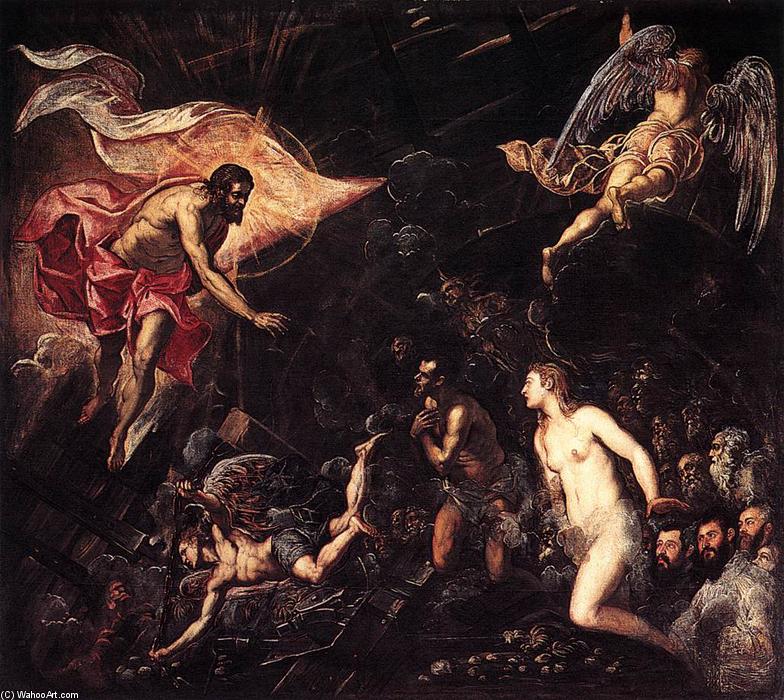
The Cure At Troy
“The Descent into Hell,” by Tintoretto, 1568

In classic Christian theology there is an image of Jesus that comes from a line in the Apostles Creed which says, He was crucified, died, and was buried.  He descended into hell.  After three days, he rose again.  Many have wondered at what Jesus was doing down there in hell for three days, waiting for his resurrection.  I like to imagine he was pulling up all the souls of the dead who, like weeds, had been tossed to the fire for burning, gathering them once again to be side-by-side with all the other good seeds.

I honestly don’t know why Jesus insists upon telling parables—these stories that make us think the world is never as bad as it seems and hope is just that good—but thank God someone does.


Crumbs All Around!

“Jesus left that place and went away to the district of Tyre and Sidon. Just then a Canaanite woman from that region came out and started shouting, “Have mercy on me, Lord, Son of David; my daughter is tormented by a demon.” …Jesus answered, “It is not fair to take the children’s food and throw it to the dogs.” She said, “Yes, Lord, yet even the dogs eat the crumbs that fall from their masters’ table” (Matthew 15:21-28).


I would like to take as my subject a single word, FAITH.

Saint Paul, arguably one of the greatest theological minds ever, said this about faith: it’s what saves us.  Martin Luther, writing some 1500 years after the time of Saint Paul, went a little farther to say, faith alone saves us.  When Paul said it, he was probably in a jail cell, locked up for preaching the Gospel, which, at that time, was equal to speaking out against the authorities.  Paul didn’t have anything against the authorities.  In his letter to the church at Rome, the same letter in which he wrote, faith saves us, Paul also wrote,

“Let every person be subject to the governing authorities, for there is no authority except from God, and those authorities that exist have been instituted by God.  Therefore, whoever resists authority resists what God has appointed, and those who resist will incur judgment. For rulers are not a terror to good conduct but to bad. Do you wish to have no fear of the authority? Then do what is good, and you will receive its approval, for it is God’s agent for your good.”

Romans, chapter 13

Paul will go on to say that, for this same reason, everyone should pay their taxes, giving revenue to whom revenue is due, and honor to whom honor is due. 

It would be easy, I suppose, to take Paul’s words as blanket approval of government.  Many have taken Paul this way, as someone who equated being patriotic with being Christian.  But one need not look any farther than to what happened in Germany in the 1920s, or way down south in America in the 1960s, to see the atrocities that come from Christians confusing love of country with love of God.  When this happens, people who say they love Jesus, risk becoming complicit in killing people who are just like Jesus.  We’re not just talking about the fact that at the time of the Holocaust in Germany, Jews made up less than 1% of the population, while Catholics and Protestants, those who called themselves Christian, made up 99% of the population.[1]  Nor are we just talking about the fact that in Mississippi in 1964, members of the Klu Klux Klan, White Knights as they were called, responsible for lynching black people and burning crosses, met in the churches where their leaders attended on Sundays.  What we’re talking about is how easily we scare in a world where faith hardly ever seems like enough to save us.

What we’re talking about is how easily we scare in a world where faith hardly ever seems like enough to save us.

It must be one of the most burned-out phrases of all time, to hear someone say: You just have to believe.  It might be the first day of school, the first day on the new job, the first day without a job anymore, or the first day after the funeral, and you’re asking yourself, can I really do this?  And someone says, of course you can, you just have to believe.  You might be alone on the floor in your kitchen, alone in the hospital bed, alone in your car on some dark city street where you didn’t mean to go, or alone in your mind.  You’re asking yourself, what if no one comes to find me?  And someone says, they will, you just have to believe.  The circumstances might be as pithy as trying to figure out how to pay this month’s rent, how to kick an addiction, or how to keep from always thinking the worst about yourself, others, or God.  You tell yourself, things will never get better.  And someone says, they will, you just have to believe.        

Granted, it’s usually the person who is already standing on the other side of some rickety bridge that we ourselves have yet to cross who says this.  “What if it doesn’t hold me?” we yell on over.  “It will,” they yell on back.  “Yes, but what if it doesn’t?”  “It will, you just have to believe!”  And we say in reply, “That’s easy for you to say.  You’re 8, you weigh 50 pounds, and you’re already on the other side!”

We know this, faith isn’t the same for everyone.  It’s not the same for everyone out there.  Heck, it’s not even the same for everyone in here.  Despite the fact that we have all showed up at the same church this morning, to sing the same hymns, to pray the same prayers, and hear the same word from God, we are far from the same when it comes to a great many other things, including our faith.  I imagine some of us came here kicking and screaming this morning, if not on the outside than on the inside.  Quite possibly, the only reason we are here is because the person beside us made us come, or asked us to come, and loving them so much, we have.  For others, it’s all we can do to whisper the hymns and murmur the prayers.  Recovering Catholics, washed out Baptists, we grew tired a long time ago of being told, you just have to believe, and then being told what it is that we have to believe.  What does it mean to believe anyway?

When I was a child, I was taught it meant being a Christian, and that being a Christian meant having the faith of my grandparents and parents—a faith grown, kept, and passed on in tradition.  When I became an adolescent, I was taught that it meant taking that faith and making it my own.  So I chose to be baptized, and I prayed to ask Jesus to be my savior, which is what we did in the tradition of my family.  The lesson was, being a Christian meant having faith in Jesus to save me from going to hell when I died.  As a teenager, being a Christian was about showing the world through good behavior that I was a Christian.  So I didn’t drink, or kiss a girl (for too long), I went to church every week, and I tried to do my best to convince anyone who was gay, Muslim, or just not Christian, that they needed my kind of faith if they wanted to be saved, too.  Then, somewhere into my adult years, I woke up one day to realize my faith felt heavy to me, burdensome, without joy.  I started to think about what it meant to keep faith in a Jesus who would save me from hell, but only if I asked him to.  What kind of faith is that?  And what kind of savior is that?  And what does it mean for Christians to put their faith in someone like Jesus who was Jewish and never a Christian himself? 

I woke up one day to realize my faith felt heavy to me, burdensome, without joy.

There are three things I want to give us today.  The first is a word of warning, the second, a word of challenge, and the third, a word of blessing.  First, a word of warning.  The late Jonathan Saks, who served as Chief Rabbi of the United Jewish Congregations of Great Britain, once wrote, “The supreme religious challenge is to see God’s image in the one who is not in our image.”  Because very often, what we believe about God—how we see God—comes from us having made it up.  I don’t mean to sound like I’m accusing anyone of committing idolatry, but you would not have to look far to see how I’ve done it.  Just check my Bible to see which pages I’ve dog-eared, and which pages are still stuck together, or check my purchases on Amazon, or survey my friends.  All will tell you that I stick close to sources that support my views and ideas.  And even when I do come across a new idea, I find myself trying to make it fit into an older, more comfortable idea.  I have never burned any crosses, but still, my ability to keep a lid on my world says a great deal about the privilege afforded me as a white, rich man in America.  None of this makes my faith better or worse than someone else’s, it’s just a reminder of how hard we must work to see God’s image in the one who is not in our image. 

“The supreme religious challenge is to see God’s image in the one who is not in our image.” 

Rabbi Jonathan Saks

Which brings me to the second word I want to give us, a word of challenge: a faith that turns away the hungry and hurting is no faith at all.  It does no good to tell someone who is hungry, don’t worry, things will get better, you just have to believe, while you’re sitting there munching on a sandwich.  Even Jesus had to learn this the hard way.  In our gospel lesson for today, he is traveling through the region of Tyre and Sidon when a Canaanite woman comes up to him asking—no, begging—for him to do something to heal her tormented daughter.   That she is a Canaanite is significant, for once upon a time her people were enemies with Jesus’ people.  When they looked at each other, neither side saw the image of God.  They saw only someone to be feared, hated, and eliminated.  The Canaanite woman knows this, that she is showing up to the clubhouse where she is never going to be let in.    And Jesus tells her just that.  “It is not fair to take the children’s food and throw it to the dogs.”  But she reminds him that he is a Jew, and his God has always been bigger than the one we imagine, bigger even than the one he imagines.  His God has never let anyone, not even the dogs, go hungry.        

The disciple named John, who wrote three separate letters, each of which appear towards the end of our Bible, said in his first letter: Those who do not love a brother or sister whom they have seen, cannot love God whom they have not seen.  In her book, Holy Envy, Barbara Brown Taylor writes the following:

You will have your own interpretation of this teaching and others like it, but here is what it reveals to me: the same God who came to the world in the body of Jesus comes to [us] now in the bodies of [our] neighbors, because God knows that a body needs a body to make things real, and the real physical presence of [our] neighbors makes them much harder for [us] to romanticize, fantasize, demonize, or ignore than any of the ideas [we] have of them in [our] head.

If I could make my neighbors up, I could love them in a minute.  I could make them in my own image, [and then tell them how wonderful they are!].  But nine times out of ten these are not the neighbors I get.  Instead, I get neighbors who cancel my vote, burn trash in their yard, and shoot guns so close to my house that I have to wear an orange vest when I walk to the mailbox.  They put things on their church signs that make me embarrassed for all Christians everywhere.  They text while they drive, flipping me off when I pass their expensive pickup truck on the right, in spite of the fish symbol on their rear bumper. 

But if you stop and think about it, what better way could there be for me to love the God I cannot see than to try for even twelve seconds to love these brothers and sisters whom I can see?  What better way to shatter my custom-made image of God than to accept that these irritating and sometimes frightening people [we call neighbors] are also made in the image of God?

From her book, “Holy Envy,” (New York, NY: Harper One, 2019, pgs. 194-95) Words in bracket [ ] are mine.

Honest to God, with a faith like that, the world would not need saving, for it would be saved already.

I said I was going to give you a third word, a word of blessing.  Here it is: Be the kind of Christian, the kind of person, the kind of neighbor today who leaves a trail of crumbs that lead straight to your own door.  And should your neighbor ever do the same for you, don’t be afraid to follow the crumbs that lead straight to their door. For in so doing, you may discover a mercy beyond your wildest imaginations.   


[1] https://encyclopedia.ushmm.org/content/en/article/the-german-churches-and-the-nazi-state


A Cosmic, Holy Order

“But when his brothers saw that their father loved him more than all his brothers, they hated him and could not speak peaceably to him… They said, “Come, let us sell him to the Ishmaelites and not lay our hands on him, for he is our brother, our own flesh.” And his brothers agreed” (Genesis 37:4, 27).

Good morning again.  For those of you who may not know me, my name is David.  I am the pastor here.  At least that’s what the sign out on the front lawn tells me.  After being away on sabbatical the last eight weeks, it is good, and more than good, it is reviving, to be back here in this place with you today.  To know you’re home because your name is still on the mailbox or hanging somewhere on the wall with all the other brothers and sisters who have ever come here looking to be known.  What a gift.  But what a gift sabbatical is as well. 

For this is what sabbatical is, or at least what it’s supposed to be: gift.  From the word sabbath and the biblical story of Genesis, a sabbatical is what God took on the seventh day of creation.  After having worked for 6 days straight, Genesis 2 records, …and on the seventh day, God rested from all the work that he had done.  In that moment, I imagine God a painter, stepping back from the canvas to get a good look at his painting.  He steps back far so he can see how it all came together.  How the sky meets the ocean, turning plain old blue into turquoise.  How the sun and moon both manage to stay always perched in the sky, never trying to outshine each other.  How the elephant sits so calmly while a funny little bird sits on its back pecking at ticks hidden away in the tangly hairs of this great, gray, gentle beast.  How Adam and Eve seem to understand so easily and so well what it means to have been included last, and not first, in the painting.  Be fruitful and multiply, God told them.  Fill the earth, subdue it, have dominion over everything you see.  Tricky words for our industrialized, American, 21st century ears to take in, but not for Adam and Eve, who must have known that when God said to subdue, God didn’t mean for them to have their way with everything, without any consideration for what would happen to them or their fellow creatures if they were to mistreat, kill, or destroy the earth.

But there are a few things we need to recall, a few things we must recall, if we are to keep from being destroyed.  First, while there is no getting around the fact that in Hebrew, the word subdue does in fact mean to subdue, even to a point of getting hostile, in Genesis chapter one there is nothing worth getting hostile over.  There are no nations, no borders, nothing to fight about.  It’s just Adam and Eve, and short of some unruly weeds they might encounter in the back yard, they have no enemies, nothing to subdue.  What does it mean, then, that God uses this word to describe what Adam and Eve are to do?  Is God setting them up for things to come?  Does God already know that, for as good as things are now—in the beginning—it won’t take long for things to get bad, and Adam and Eve should prepare now for that day when they will need to subdue and dominate?  No, I don’t believe so. 

Read the whole of Genesis chapter one and what we see is that God is not the kind of painter who just throws paint on the wall willy-nilly.  Inventive, surprising, and unpredictable as God is, there is equal purpose and order to the way God goes about creating the world.  God begins with darkness, and then uses the darkness to call forth light, from which comes the day, from which comes the night.  On the second day of creation, God adds the sky, from which then comes the sun, moon, and stars.  On the third day, the earth appears, and from the earth, fruits and vegetables, which grow in seasons made possible only by the turning of the sun and moon.  Then there are the waters, which, along with the birds, come from the sky.  You see how it works?  Everything depends upon everything for its life, indeed for its very survival.  Nothing and no one can afford to fight for dominance, or to act with intolerance and indifference towards the earth or each other.  For God made us in such a way as to make it impossible for us to go it alone.  We need each other.  We are part of a great cosmic, holy order, what the late Frederick Buechner calls an alphabet of grace.  Each of us a letter that, on its own, can be meaningless, or can be part of great meaning.  This is us—an alphabet of grace, a holy order of love that must be honored, respected, and tended to as such. 

Of course, we know through painful experience that sometimes, most of the time, things get out of order—we forget our place in the world.  When this happens, order must be reestablished.  In a word, we must subdue, and be subdued ourselves. 

I thought about this and read for us a piece of the Joseph story from Genesis 37, a reminder of what can happen when things get out of order, and pride, jealousy, and fear are allowed to dominate at the front of the line.  In the Joseph story, Joseph, the second youngest of 12 sons born to his father Jacob, is sold into slavery by his brothers.  Here’s how it happened: Jacob, having two wives named Leah and Rachel, loved Rachel the most.  But for years, Rachel could not get pregnant, and pregnancy, being a badge of honor for a woman back then, made Rachel’s barrenness a point of disdain for her and her husband.  I have been cursed by God, is what Rachel told herself lying in bed each night.  

For better or for worse, however, ancient Mesopotamian society provided a back-up plan for women like Rachel.  If unable to become pregnant, she could give her slave woman to her husband to become pregnant for her.  Which is what Rachel does; she gives her slave Bilhah to Jacob. 

That Rachel even has Bilhah to give says a great deal about Jacob and Rachel.  They are people of economic means in this world, and Rachel, though feeling powerless in her role as a wife and woman, uses those means to prove she is still more powerful than some.  Who among us hasn’t, from time to time, done this very thing?  Standing at the back of the line, we cry, I don’t belong here!  Do we ever stop to think, though, about the fact that what the person directly in front of us hears in that moment is, I am better than you

In the case of Rachel, crying out from the back of the line will only get her so far.   For, in the end, any children Bilhah may have will belong to Bilhah and Jacob, not Rachel and Jacob.  You see, this is not a surrogacy situation between the two women.  It is simply a way for Rachel to save what little face she can.    

Bilhah will have children, two boys.  Much to everyone’s surprise, Rachel will wind up becoming a mother as well, giving birth to two boys of her own, Joseph and Benjamin.  All told, Jacob will have 12 sons by 4 women.  But here’s the rub, Rachel, whom he loves the most and only ever wanted to be with, will die first.  Leah, whom he had to marry but, really, never wanted to, will live on in the book of Genesis with barely a mention.  And Bilhah and Zilpah, Rachel and Leah’s slave women, they of course are never mentioned again.         

In the end, what will remain is Jacob and his 12 sons.  They and they alone make up the story line of 13 chapters in the book of Genesis, beginning in chapter 37 when 10 of the brothers decide to sell Joseph into slavery.  The only reasons we are given for this cruel move on their part is that they see how their father loves Joseph more than them, and they hate Joseph for it.  But a closer look at the story and we find, as always, there is more to it.  In verse two, Joseph is in the fields helping his brothers tend the family herd.  Specifically, he is said to be helping four of his brothers, the four who were born to Bilhah and Zilpah.  Boy, it must have torn Joseph up to hear his father say, go help those ones.  With Rachel dead, he, the favorite son of his father’s favorite wife is being made servant to the sons of the servants.  Bilhah had been brought in to do what Joseph’s own mother could not.  Do you think, while they were out tending the sheep, their father back in the house, the sons of Bilhah and Zilpah might have dug into Joseph about it.  You know, Joseph, our mothers might have been slaves, but at least they were masterful at being women.  Your mother, she wasn’t even a full woman.  And you think you’re better than us, Joseph?

Then, one day, Joseph, perhaps looking to put them in their place, snitches on them to their father.  What dirt Joseph had on them, we don’t know, and it doesn’t matter.  The point is, in going to dad to rat out his brothers, Joseph is pushing back.  He knows his father will listen to what he has to say and believe it.  After all, he is the favorite son.  Better than me?   Ha!  I’ll show my brothers who’s better.    

It’s hard to say who’s to blame for the way things turn out.  If Joseph had just not acted so arrogant and privileged; if his brothers had just not given in to revenge and slavery; if their mothers had just been there to tell them all to knock it off; if their dad had just loved them all the same when they were young; if they could have all just stepped back in that moment to recall the way it’s supposed to be, the way God made us—an alphabet of grace, a cosmic, holy order of love, each of us a gift, no one better than another.

Ernest Hemingway, author of Old Man and the Sea, once said, “There is no nobility in being superior to others.  The only nobility is in being superior to our former self.”

In 2020, The 1619 Project was published by the New York Times.  As part of the project, Khalil Gibran Muhammad reminds us in her essay titled, Sugar, that when Africans started getting bought, sold, and shipped as slaves between Great Britain, the West Indies, and the American Colonies, it wasn’t just the southern colonies who were guilty of getting involved.  From 1709 to 1809, from what is now the stretch of land between Fox Point and India Point in Providence, Rhode Islanders made over a thousand voyages to Africa, procuring 106,544 enslaved persons.[1]

I’d like to think we have come a long way from our past, that we have learned the wisdom of Hemingway: “There is no nobility in being superior to others.  The only nobility is in being superior to our former self.”  But if you woke up today worried for a world still stuck in an old order, I offer you one final thought.

As part of my sabbatical, I spent five days back at the Society of Saint John the Evangelist, a monastic community of 11 brothers in Cambridge, Massachusetts.  On my last day there, a Sunday as it would so happen, Moira, Lillian, and Rowan drove into the city to go to church with me.  I think it’s safe to say, both kids were curious to see how monks live.  Everyone wearing the same black habit, tied off at the waist with a simple rope.  A pair of sandals on their feet.  All day long they walk about not in total silence but in a quietness so practiced it feels natural; gathering to pray 5 times per day, working only to give away what they make to the poor.  To the uncurious, their life together might appear boring, unproductive, irrelevant, pointless. 

On the day Moira and the kids came in to meet me, it was a sunny, unusually cool July day, perfect for gathering in the monastery gardens after church for a time of fellowship hosted by the brothers.  Over a glass of lemonade and a piece of zucchini bread, one of the brothers mentioned that they used to have a dog living at the monastery, a black lab who would roam about the hallways, greeting guests and stealing scraps from the kitchen.  “He was systemically starved,” Brother Curtis said with a laugh and a soft, far-off look in his eyes.  “Will you ever get another dog?” Rowan asked.  “Some of us would like to,” said Brother Curtis, “I want one very much, but not everyone does.”  Rowan was quick to make the connection.  “That sounds a lot like our family, except we do have a dog.  Why don’t you all just vote on getting a dog?”  “Well, sometimes that can work,” Brother Curtis said with a smile, “but there are certain things you need everyone to agree on.”  “You mean everyone has to say they want a dog before anyone can get one?  That seems like it will never happen,” Rowan exclaimed.  “No, we don’t all have to want a dog, but we do all have to agree that if we get one, we will all love the dog.”

“I really only love God as much as I love the person I love the least,” said Dorothy Day once upon a time.

If the Bible begins in Genesis with these words, In the beginning God created the heavens and the earth—an alphabet of grace, a cosmic, holy order born in love— it ends in Revelation with these words, And behold, I saw a new heaven and a new earth.

I heard someone ask a question not too long ago about why people go to church.  “Do you go to be with the people you love, or do you go to love the people you are with?”  Both can have their good points, and I don’t know your reason for being here today, but can we all agree that, in being here, we will all love? 

And behold, I saw a new heaven and a new earth.


[1] Khalil Gibran Muhammad, from her essay, Sugar, (“The 1619 Project,” NY: The New York Times Company, 2021), p. 80, ref. The Transatlantic Slave Trade: A History, rev. ed. (Lincoln: University of Nebraska Press, 2005), 212-13.