Sharing a Bunk with Hitler

When I was in seminary working on my master’s degree, I had a friend there named Tom who was a PhD student.  By the time I met Tom, he had been at it for several years and was nearing the end of his program; all that was left for him to do was defend his dissertation before a committee of professors, all of whom were considered experts in the fields of theological study and biblical interpretation.  I don’t recall the exact title of Tom’s dissertation, only the main premise, which was, why I’ll be sharing a bunk in heaven someday with Hitler.  It wasn’t a question.  Had it been a question, quite possibly it would have been, why should I share a bunk with Hitler in heaven someday?  The inference being either that I’m too good to have to share a bunk in heaven someday with the likes of Hitler or that there’s no way someone like Hitler is good enough to share a bunk with me, let alone to get into heaven someday.  But it wasn’t a question, it was a statement.  Why I’ll be sharing a bunk in heaven someday with Hitler. 

I don’t know what you believe about heaven—where it is, what it’s like, how we’ll know when we’ve arrived there, or who can expect to be there.  For all we can imagine about heaven, the one thing classic Christian teaching has worked hard to make clear is that heaven is not here, which means it is also not now.  It is up there—in the sky, far above the clouds, a land flowing with milk and honey, where the streets are paved with gold, lions lay down with lambs, and we can be with our loved ones again.  In heaven, everything that has been wrong here on earth is made right again.  The broken are made whole, the hungry are fed, crying is no more, sorrow is no more, pain is no more.  A new creation, the prophet Isaiah once declared it to be.

I suppose, if we think of heaven this way, it’s not hard to imagine that, indeed, it must be in another time and place.  For if this world we are in now is heaven, then all we can say about heaven is, it’s the same old same old.  What a blow.  But if heaven is still out there somewhere, then we have reason to hope that this world in all its faded glory is not all there is. It is this hope that gets sung about in many old-time hymns.  Hymns like “How Great Thou Art,” “Just a Closer Walk with Thee,” “Amazing Grace,” and “The Old Rugged Cross.”

To the old rugged cross I will ever be true, its shame and reproach gladly bear.  When God calls me someday to my home far away, there God’s glory forever I’ll share.  So I’ll cherish the old rugged cross, till my trophies at last I lay down.  I will cling to the old rugged cross and exchange it someday for a crown. 

Lyrics by George Bennard, 1912
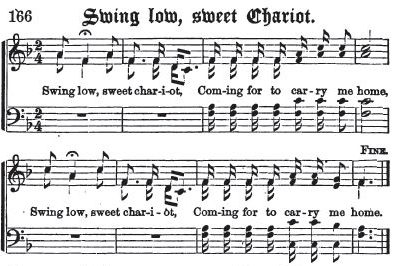
The picture we get here is of a pilgrim who is only passing through this world.  For this weary traveler, the cross is a pleasurable burden, one they carry in hope of one day being able to cash it in at the gates of heaven for something richer, like a crown.  Contrast this with the picture we get, however, in other hymns like “Swing Low, Sweet Chariot,” “Every Time I Feel the Spirit,” and “I Want Jesus to Walk with Me.” African American Spirituals, all of them first sung, perhaps, in the cotton fields of Virginia, the buses in Montgomery, and the streets of South Africa; sung by enslaved persons who looked to God not in hope of their own crowning someday, but of crowning justice and equality today.

It is curious to note that when Jesus was asked one day about how to get into heaven, the person asking the question assumed heaven to be someplace else, and those who get in to be those who are “good.” 

Good teacher, what must I do to inherit eternal life?

From the Gospel according to Mark, chapter 10

The question comes from a young man who is, we are told, well-off and therefore thinks in terms of what he stands to inherit someday.  However, this man has a dilemma.  His dilemma is, he also thinks inheritance is subject to good behavior.  Which is it?  In the end, do we get what we get—some, trust funds and crowns, others, pain and poverty—because of who we came from, or because, no matter who we came from, we are good?  Jesus, seeing the man’s dilemma, cuts right to the heart of the matter.  Why do you call me good?  No one is good but God alone.  For Jesus, the answer to eternal life is not to figure out how to be good, for no one, not even Jesus apparently, is good.    But lest we think this means being good doesn’t matter, Jesus tells the man, Go, sell what you own, and give the money to the poor, and you will have treasure in heaven; then come, follow me.  What does Jesus mean by this?  Was Jesus a socialist who believed only the materially poor can get into heaven?  Or was he a capitalist who believed it’s possible to buy your way into heaven?  Or was he both, believing that you can buy your way into heaven by becoming materially poor?  I think it’s fair to say Jesus wanted this man to see what it would be like to depend upon the poor for his inheritance.  To stand at heaven’s gate and realize you have nothing with which to cover your entrance fee, but that’s okay because having nothing is what gets you in.    

From The New Yorker, 8/2/2013

I heard an interview once with Martin Sheen, the Hollywood actor.  A devout catholic who has also been arrested over 60 times for protesting things like war and nuclearism, he was asked in the interview what brings him joy.  He described standing in line every week at church to receive communion.  “For the most part I stand in that line and I am so stunned to be there that all I can say is, thank you.  And when the bread is handed to me, and the cup offered to me, if anyone ever asked me why I should get to have them, I’d have to look at all the other people in line with me, and all I’d be able to say is, ‘I’m with them.’”     

It isn’t something that just happens, though. Just because we think we’re in with Jesus doesn’t mean we are. When Jesus tells the man who wants to get into heaven that all he must do is go sell what he owns, give the money to the poor, and come, follow me, the man turns and walks away sad.  It turns out, heaven is not far away for this man after all; he is standing right on the doorstep, one step away from being in line.  But he will not be getting into heaven today, and it is not because he is rich, it is because he does not want to be counted with those who get in for nothing.  What a dilemma.  

To stand at heaven’s gate and realize you have nothing with which to cover your entrance fee, but that’s okay because having nothing is what gets you in.    

Such was the dilemma also faced by a guy named Jonah.  In the whole Bible, Jonah’s story is only four chapters long.  It begins with God calling Jonah to go to Ninevah.  “Get up Jonah, go to Ninevah.  That city has become overrun with sin and wickedness.  Preach your best judgment upon them.” 

Jonah, we know, was a Hebrew, and the Hebrew people had a history of being enemies with the Ninevites,  and so this should have been an easy assignment for Jonah.  Heck, bringing judgement down upon your enemies should be an easy one for anyone.  Except when Jonah gets the call from God, rather than go to Ninevah, Jonah gets on a boat and heads away from Ninevah.  And why?  It’s simple really.  Jonah is a Hebrew, which means that in addition to belonging to a country and having a national identity, he also belongs to God.  As he tells his shipmates, “I worship the Lord, the God of all creation,” which means Jonah’s god is not only Jonah’s god but also the God of all creation, who must care not only for Jonah and the Hebrews but also for the people of Ninevah.  So Jonah doesn’t go to Ninevah.  How can I go to Ninevah and preach that I’m #1 when I know that’s just not true?  God has a way, though, of turning even the proudest heart, and when Jonah does eventually arrive in Ninevah to preach his sermon, and the congregation hears it, they change their ways.  They turn from evil to God, and God, God of course turns to them.  And Jonah turns away from the whole thing.  He goes out of the city and finds a lonely hillside to sit on all by himself, and there he sulks. I knew you wouldn’t go through with punishing the people of Ninevah, God!  I just knew you wouldn’t. You who are slow to anger and abounding in love.  But if you weren’t going to do it, why did you bring me all the way out here to say you were going to?

Jonah never receives an answer to his question.  The story of Jonah just ends rather abruptly, with God asking a question and Jonah left having to think about it. 

“Should I not be concerned about Nineveh, that great city, in which there are more than a hundred and twenty thousand persons who do not know their right hand from their left and also many animals?”

Jonah, chapter 4

In other words, if it bothers you that I care so much about the people, you’re going to love the fact that I care just as much about the animals. 

For all the folklore surrounding the story of Jonah, it is, in the final analysis, a story with great practical implication.  One can think of Jonah when they think of any number of issues we face today as a society.  Like, what does our care for the environment say about our care for others?  As people, do we think critically about our view on heaven, where it is and who we expect to find there?  And, how does our view affect our daily compassion towards those whose religion, faith, behavior, or morals are different from our own, those whom we don’t expect to share a bunk with in heaven someday? 

I thought of Jonah this past week when I was at my local library.  I sit on the Board of Directors at the library and as part of our monthly meeting we were discussing the impact efforts to ban certain books from public libraries has had on our communities.  As complex and politically charged as this issue has become in so many towns and cities, one board member reminded us that book banning isn’t really about books.  Good parenting has always meant being involved in our children’s lives, including knowing what they are and are not reading.  But banning books really isn’t about good parenting, or good books for that matter.  It’s about who gets to decide which stories get told alongside our own.  As the Nazis did in Germany during World War II when burning books was a way to keep people from imagining any other world than the one Hitler wanted for them— a world of hateful exclusion, of death and destruction. 

But banning books really isn’t about good parenting, or good books for that matter. It’s about who gets to decide which stories get told alongside our own.

Jonah didn’t want to go to the people of Ninevah.  He didn’t want to risk finding out that in the heart of God, his story and their story are inextricably bound together by love and mercy.  That God found a way in the end to get Jonah to Ninevah anyway is, in and of itself, an act of love and mercy.  For God would have us find out that there is a bunk, a resting place, out there in the world today and—surprise-surprise!—room even for us.   

Accessing The Holy

This is a story about a parking lot.

In the first church I worked there was a woman named Maggie.  Her actual name was Magnes, which is why, according to her, she asked everyone to call her Maggie.  Every Sunday Maggie would come to church and sit, along with 3 or 4 other women, in the back pew, as close to the exit as anyone could get.  There was something about all these women that was remarkably similar.  They all had wrinkles on their hands and forehead, they all wore fancy hats, and they all walked a bit hunched over with a swagger that came from being 80-years old.  Like Maggie, they also all came alone, most of them driving either a tiny Ford Escort, all that their fixed income could afford, or a Cadillac the size of a Carnival cruise ship.  They drove those cars always thinking about what it used to be like to sit in the passenger seat, back when their husbands were alive and did all the driving. 

For Maggie, however, there was now Gary.  At the time I met Maggie, she and Gary had been married just a few years.  I remember Maggie telling me plainly, “Gary was convenient.”  Gary, a widow himself, could never survive the future without someone to cook and clean for him, and Maggie couldn’t survive the future without someone to pay for the food.  So they got hitched.  Gary’s grown daughter Suzy wasn’t crazy about the arrangement.  It mostly had to do with Maggie, whom Suzy felt was only looking for an inheritance from Gary.  Mind you, Suzy wasn’t mean, not at all.  She cared about Maggie and about seeing Maggie cared for, and she didn’t mind her father helping Maggie out.  She was also grateful for Maggie and the around-the-clock care she gave to her father, who sadly, just after getting married to Maggie, was diagnosed with cancer.  What Suzy did mind was seeing her father be generous to someone who hadn’t done for him nearly as much as she—the twinkle in her daddy’s eye for 64 years—had done.  Call it the plight of the Prodigal’s older sister, call it the luck of the worker who shows up at closing time and gets paid the same as the worker who put in an 8-hour day, sometimes there is nothing harder for us to take than grace when it is given to somebody else.

To make matters even harder, Maggie’s only son, Roy, whom Maggie would say, “never really had a father,” showed up at the door one day looking for a place to live, and Gary rolled out the welcome wagon for him, giving Roy, of all things, Suzy’s old bedroom to sleep in.  Roy needed this grace because, well, along with Gary, he too was dying from cancer.  For Roy, it wasn’t the first time.  When he was just three, he was diagnosed with cancer.  He fought and beat it then.  But it cost him a kidney, and for the next 47 years Maggie kept telling her son, “You’re special,” and Roy believed her.  I’m sure it’s what brought him to show up on Gary’s front step, and what brought Maggie, on the day Roy died, to ask me if the church would allow her son a funeral service. 

He’s not a member, you know, she told me.  And he never even comes to church.

I don’t think God cares about any of that, I told her. 

Well, no, I suppose not, but maybe the church does?

No, we don’t care about any of that either, I assured her, half assuring myself as well.

What about his past though? Maggie added.  I mean, Ray had a past.

Don’t we all, I thought.  Tell me about it, tell me about Roy’s past.

Well, when he was 23, he called me up to say, ‘Mom, I’m an alcoholic and a drug user.’ 

I bet that was hard to hear.  What did you tell him?

I told him what I’d always told him.  “You’re special.”  Then, I got him some help, found him an AA group to be a part of.

And did it?  Did it help?

Yes, I think so.  He moved around a lot—Florida to California and back to Florida.  I didn’t always know where he was or how he was doing, but he was special, he was very special.

On the day of Roy’s funeral at the church, the service was at 10 a.m.  At 9:30, the parking lot, which held 300 cars, was jam packed under a haze of cigarette smoke.  Curious—and admittedly, a bit annoyed—I stepped outside to see what all the commotion was about.

Good morning, I said to a man standing near the door. 

Oh, ah, good morning.  I hope you don’t mind, reverend, it calms us down, he said, tucking his cigarette ever so slightly behind his back. 

In my head, I was trying to figure out what was going on.  The way Maggie told it, I figured we were going to be lucky to fill up one pew at the funeral.  Are you, are you all here for Roy? I ask the man still puffing on his cigarette.

Well, we’re not here for you, he said with a cheeky grin. 

If you don’t mind me asking, how do you all know Roy?

And that’s when he told it to me, the Gospel like I’d never heard it before.  We all know him from being in NA and AA together.  He sponsored nearly all of us.  If not for Roy, most of us wouldn’t even know the word recovery.  Because of Roy, we know it’s more than just a word.

At the funeral, I learned that, at one time or another, Roy had sponsored 225 people through NA or AA.  One of them got up to read a story about Jesus and Matthew. What a crazy story this is. 

As Jesus was walking along, he saw a man called Matthew sitting at the tax-collection station, and he said to him, “Follow me.” And he got up and followed him.

Matthew, chapter 9, verse 9

Jesus calls Matthew to follow him, and Matthew does.  There are no negotiations, no promises made.  Jesus doesn’t say, Follow me, Matthew, and I’ll throw in an all-expense paid trip to Bermuda.  Matthew doesn’t say, I’ll follow you, Jesus, so long as you agree to pay me more than what I’m making now as a tax collector.  With other disciples, Jesus at least promised that the work they’d get to do with Jesus would be both personally and professionally more fulfilling.  Follow me, Jesus said to Peter and Andrew—two fishermen who weren’t very good at fishing—follow me and I’ll make you fish for people.   

But with Matthew it’s a simple directive.  Follow me.  And Matthew does.    

I don’t know what makes Matthew do it.  Maybe he was tired of running the rat race, fed up with being a hatchet man.  Everyday his job was to not care about whether you could afford to buy groceries or to keep a roof over your head, so long as you paid your taxes, so long as Rome got richer.  It was degrading work, degrading to Matthew’s soul.  But it was a runaway train and Matthew didn’t know how to get off.  Then, one day, Jesus comes along and throws him a lifeline.  “Follow me.”  And Matthew does.

Next thing we know Matthew is throwing a dinner party. 

And as he sat at dinner in the house, many tax collectors and sinners came and were sitting with Jesus and his disciples. When the Pharisees saw this, they said to his disciples, “Why does your teacher eat with tax collectors and sinners?” But when he heard this, he said, “Those who are well have no need of a physician, but those who are sick. Go and learn what this means, ‘I desire mercy, not sacrifice.’ For I have not come to call the righteous but sinners.”

verses 10 – 13

Jesus is there and all of Matthew’s former co-workers are there as well.  Tax-collecting low-lifes.  What can you say?  If there’s nothing harder to take than grace when it is given to someone else, there is nothing greater than taking the grace you’ve been given and sharing it with others. 

Of course, and this is what gives grace its name, as far as we can tell, Matthew wasn’t asking for it.  He wasn’t even looking for it.  Not until Jesus comes along to tell him there can be something more does Matthew even realize more exists.  But once he has it, there’s no keeping it to himself. 

You understand, this is not a story about a parking lot.  It is about what can happen when we give each other full and equal access to holy places.  And we need holy places in our world today.  We need them in Morocco and in Ukraine.  We need them in Washington, and anywhere else we’d like to call home.  Places where hope meets us at the door and call us by our one true name.  Where recovery is not just a word, but a thing we work for together.  Where grace surprises us at every turn. 

Little Flock

“Therefore I tell you, do not worry about your life, what you will eat, or about your body, what you will wear… For it is the nations of the world that seek all these things, and your Father knows that you need them… Do not be afraid, little flock, for it is your Father’s good pleasure to give you the kingdom.  Sell your possessions and give alms. Make purses for yourselves that do not wear out…” (Luke 12).

I read an article recently about how little things are dying just as big things are getting bigger.  I suppose the article could have been talking about any number of realities, but it wasn’t.  It was talking about the church in North America.[1]  Frankly, I find the article to be a dime-a-dozen.  Regarding the North American part of this reality, one might argue that getting bigger has been the recipe from the beginning.  We’ve always been getting bigger, or at least wanting to be.  One of the first topics we cover in school as children, next to basic math and learning to write our name, is the explorers.  Essentially, what we are after is the answer to such questions as, how did we get here?  Who got here first?  And where did they come from?  As a fourth grader growing up in New England, my answers amounted to nothing more than a list of names and places.  To Coronado we owed the southwest, including the discovery of the Grand Canyon; to de Soto we owed Texas; to Ponce de Leon we owed Florida and that elusive fountain of youth; to Christopher Columbus we owed the Bahamas; and to that hearty band of pilgrims who left England in 1620 for fairer shores, we owed everything.  Am I right about this?  Maybe it was just my generation, or my family and church who said that while Columbus discovered America, it was the Pilgrims, landing on Plymouth Rock in 1620, who gave us America.  Fleeing the persecutions and idolatries of the Church of England, they risked life and limb to set sail for a land where they could live and worship freely, the way they wanted to.  For right or wrong, this was the story of America I was told, and this is the story I bought into.  As such, this was a story about an America where not just ideals and dreams are supposed to be bigger, but where God is supposed to be bigger, and where God is behind the getting bigger.     

And so, it was not hard for America’s first pilgrims to regard this land as their manifest destiny, God’s divine gift to them, meant for them to have, that in having it they might also enlarge it.  For a gift left untouched and unused is but a destiny left unfulfilled. 

History has shown that in the early years of Plymouth Plantation, life was governed somewhat successfully by a series of treaties and compromises made between the Pilgrims and the natives, whose homeland the Pilgrims were living on.  This would not change the fact, however, that, to the Pilgrims, the natives were considered savages, likened to the Canaanites they had read about in their Bibles, the ones about whom the Israelites once said, “They are giants, and we’ll never take them,” but about whom their leader Moses said, “If the Lord is pleased with us, he will bring us into this land and give it to us.”[2]  We can take them, it is our manifest destiny.  And take them they did.  In the first 225 years of the founding of the United States, upwards of 100 million Native Americans were forcibly removed from their homes, ultimately to die from the spread of unwarranted and unmitigated disease, warfare, and genocide at the hands of those whom today most of us call our American ancestors, who believed it was their destiny to get bigger.

I don’t share this bit of history in order to make social or political hay, or to spark confrontation with anyone whose version of the story may be different.    Plus, surely someone will say, you can’t have it both ways, you can’t say the church isn’t called to have a national identity and then use the pulpit to talk about America.  Fair enough.  I admit, figuring out how to speak of God and America in the same sentence is as complicated and complex as trying to figure out how to tie your shoes.  There’s more than one way to do it, and some people just choose to wear slip-ons.    

Just the same, we must reckon with the fact that, to whatever degree history gets told by the victors, in America, it was the church-goers—and by “church-goers” we mean those who once-upon-a-time dared to invoke the name of God in declaring independence for themselves—We hold these truths to be self-evident, that all men are created equal, that they are endowed by their Creator with certain inalienable rights, that among these are life, liberty, and the pursuit of happiness—it was the church-goers who also stipulated that enslaved persons, black persons, counted as only three-fifths of a person.  It was the “church-goers,” the so-called Christian missionaries, who, in the spirit of manifest destiny, landed upon the shores and moved across the frontiers, but who left in their wake trails of tears upon which Cherokee, Choctaw, Chickasaw and so many others were forced to march from their homes to go live on reservations, reservations whose dignity to this day is threatened by poor access to healthcare, education, and corporations who would steal their land for profit.  And it was the “church-goers” down south, and up north, whose houses of worship and personal fortunes were made bigger and bigger by the hands of people they would never actually allow into their churches.  

Wren Chapel

Many years ago, I visited the Wren Building on the campus of The College of William and Mary in Williamsburg, Virginia, the second oldest academic institution in the country.  The Wren Building, constructed in 1700, is the oldest academic building still in use today.  Within the building are several classrooms, offices, and a chapel.  As part of the chapel there is a small balcony. I remember learning that, back in colonial days, the balcony is where enslaved persons sat, while their white masters sat down below.  One might think slaves wouldn’t even have been allowed in church back then.  However, their masters wanted them there, to hear the sermon.  A typical sermon being one that served to remind enslaved persons that their station in life was by God’s design. 

I am glad to say that if you go to the campus today, there is a memorial bearing the names of people who were enslaved by the college over a period of 172 years, some of whom, undoubtedly, built the chapel.       

When we consider how getting bigger has been the way of it for America since her beginning, and how the church, for better or worse, has helped her in her quest, it should not surprise us if we, as a church, should feel a certain desire to always be getting bigger as well.  I know I feel this way sometimes.  As embarrassed as I may be to admit it, on both a personal and professional level, I want bigger crowds, a bigger budget, a bigger safety net.  I feel better when people are asking, what can I do?  Rather than, do I have to do that again?  When my brain is feeling inspired, not empty.  When I am not thinking about how to keep something going, because I am too busy trying to keep up.  When we, with our ten thousand other things to do, couldn’t be happier to put it all down and show up to church for another Sunday.  Yes, I too would like to be bigger.    

But who am I kidding?  If the article I read recently is any indication, only those churches that are already big are getting bigger, while the little ones are dying.  Of course, the article didn’t say what constitutes “big” or “little,” leaving open the possibility, I guess, that 2 people could be considered big, and 2,000 people could be considered small. 

What I find interesting is what Jesus says: Do not be afraid, little flock.  At the time he said it, Luke records there were thousands in the crowd, so many people that they began trampling on one another.[3]  Some were sick, so sick they were dying, and they just wanted to get close enough to have Jesus touch them.  Others were lonely and wanted to get close enough to have Jesus hug them.  And others just wanted to get close enough just to hear what wisdom or hope he might have to offer.  There were thousands of them, and Jesus called them a “little flock.”  It’s almost as if Jesus knows, no matter how big we get, we’re still just a little flock. 

The truth is, we can super-size our order at the drive-thru all day long and build houses as big as old Solomon had in all his glory, but we’re still going to be found wanting.  We can live to see the greatest medical achievements of all time, but there will always be something that can kill us.  We can work our fingers to the bone putting food on our table, and even on our neighbor’s table, but the poor we will have with us always.  We can be as big as an empire, protected and preserved on all sides, but still, we’ll be a little flock, wishing we could be bigger.  So, take heed: do not be afraid, little flock.  Do not be afraid for your life, what you will wear, what you will eat.  For it is the nations who worry about all these things, and you are not a nation.  

If we take Jesus at his word here, it would be easy to take him as reckless.  Do not worry about what you will wear or what you will eat.  “Man, are you crazy!  Everyone needs to eat, and some already haven’t had a bite in days!”  But it would be a mistake to take Jesus as saying that in this world possessions do not matter.  For what Jesus says is, it is God’s good pleasure to give you a kingdom, and in this kingdom, possessions matter greatly, because in this kingdom people will sell their possessions to provide for the poor. Because in this kingdom, sharing, generosity, and human equality rule.  In this kingdom, purses will be stuffed with a kind of riches that will never run out, the riches of brotherhood and sisterhood.  In this kingdom, a piece of bread broken and offered in grace will be worth a feast.  So, take heed little flock, and do not be afraid, there is a kingdom, God’s own, and it belongs to you. 


[1] https://www.npr.org/2023/07/14/1187460517/megachurches-growing-liquid-church

[2] Numbers 13:32; 14:8.

[3] Luke 12:1