
“Therefore I tell you, do not worry about your life, what you will eat, or about your body, what you will wear… For it is the nations of the world that seek all these things, and your Father knows that you need them… Do not be afraid, little flock, for it is your Father’s good pleasure to give you the kingdom. Sell your possessions and give alms. Make purses for yourselves that do not wear out…” (Luke 12).
I read an article recently about how little things are dying just as big things are getting bigger. I suppose the article could have been talking about any number of realities, but it wasn’t. It was talking about the church in North America.[1] Frankly, I find the article to be a dime-a-dozen. Regarding the North American part of this reality, one might argue that getting bigger has been the recipe from the beginning. We’ve always been getting bigger, or at least wanting to be. One of the first topics we cover in school as children, next to basic math and learning to write our name, is the explorers. Essentially, what we are after is the answer to such questions as, how did we get here? Who got here first? And where did they come from? As a fourth grader growing up in New England, my answers amounted to nothing more than a list of names and places. To Coronado we owed the southwest, including the discovery of the Grand Canyon; to de Soto we owed Texas; to Ponce de Leon we owed Florida and that elusive fountain of youth; to Christopher Columbus we owed the Bahamas; and to that hearty band of pilgrims who left England in 1620 for fairer shores, we owed everything. Am I right about this? Maybe it was just my generation, or my family and church who said that while Columbus discovered America, it was the Pilgrims, landing on Plymouth Rock in 1620, who gave us America. Fleeing the persecutions and idolatries of the Church of England, they risked life and limb to set sail for a land where they could live and worship freely, the way they wanted to. For right or wrong, this was the story of America I was told, and this is the story I bought into. As such, this was a story about an America where not just ideals and dreams are supposed to be bigger, but where God is supposed to be bigger, and where God is behind the getting bigger.
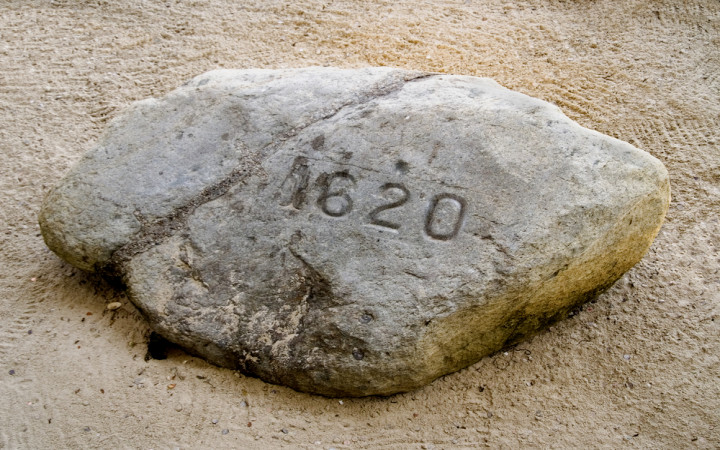
And so, it was not hard for America’s first pilgrims to regard this land as their manifest destiny, God’s divine gift to them, meant for them to have, that in having it they might also enlarge it. For a gift left untouched and unused is but a destiny left unfulfilled.
History has shown that in the early years of Plymouth Plantation, life was governed somewhat successfully by a series of treaties and compromises made between the Pilgrims and the natives, whose homeland the Pilgrims were living on. This would not change the fact, however, that, to the Pilgrims, the natives were considered savages, likened to the Canaanites they had read about in their Bibles, the ones about whom the Israelites once said, “They are giants, and we’ll never take them,” but about whom their leader Moses said, “If the Lord is pleased with us, he will bring us into this land and give it to us.”[2] We can take them, it is our manifest destiny. And take them they did. In the first 225 years of the founding of the United States, upwards of 100 million Native Americans were forcibly removed from their homes, ultimately to die from the spread of unwarranted and unmitigated disease, warfare, and genocide at the hands of those whom today most of us call our American ancestors, who believed it was their destiny to get bigger.
I don’t share this bit of history in order to make social or political hay, or to spark confrontation with anyone whose version of the story may be different. Plus, surely someone will say, you can’t have it both ways, you can’t say the church isn’t called to have a national identity and then use the pulpit to talk about America. Fair enough. I admit, figuring out how to speak of God and America in the same sentence is as complicated and complex as trying to figure out how to tie your shoes. There’s more than one way to do it, and some people just choose to wear slip-ons.
Just the same, we must reckon with the fact that, to whatever degree history gets told by the victors, in America, it was the church-goers—and by “church-goers” we mean those who once-upon-a-time dared to invoke the name of God in declaring independence for themselves—We hold these truths to be self-evident, that all men are created equal, that they are endowed by their Creator with certain inalienable rights, that among these are life, liberty, and the pursuit of happiness—it was the church-goers who also stipulated that enslaved persons, black persons, counted as only three-fifths of a person. It was the “church-goers,” the so-called Christian missionaries, who, in the spirit of manifest destiny, landed upon the shores and moved across the frontiers, but who left in their wake trails of tears upon which Cherokee, Choctaw, Chickasaw and so many others were forced to march from their homes to go live on reservations, reservations whose dignity to this day is threatened by poor access to healthcare, education, and corporations who would steal their land for profit. And it was the “church-goers” down south, and up north, whose houses of worship and personal fortunes were made bigger and bigger by the hands of people they would never actually allow into their churches.
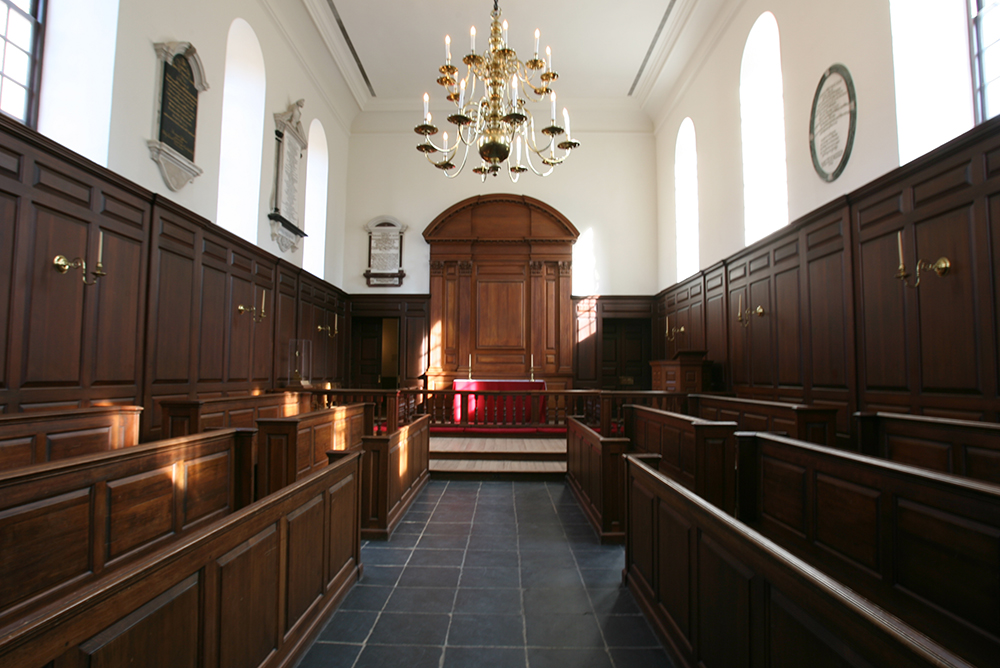
Many years ago, I visited the Wren Building on the campus of The College of William and Mary in Williamsburg, Virginia, the second oldest academic institution in the country. The Wren Building, constructed in 1700, is the oldest academic building still in use today. Within the building are several classrooms, offices, and a chapel. As part of the chapel there is a small balcony. I remember learning that, back in colonial days, the balcony is where enslaved persons sat, while their white masters sat down below. One might think slaves wouldn’t even have been allowed in church back then. However, their masters wanted them there, to hear the sermon. A typical sermon being one that served to remind enslaved persons that their station in life was by God’s design.
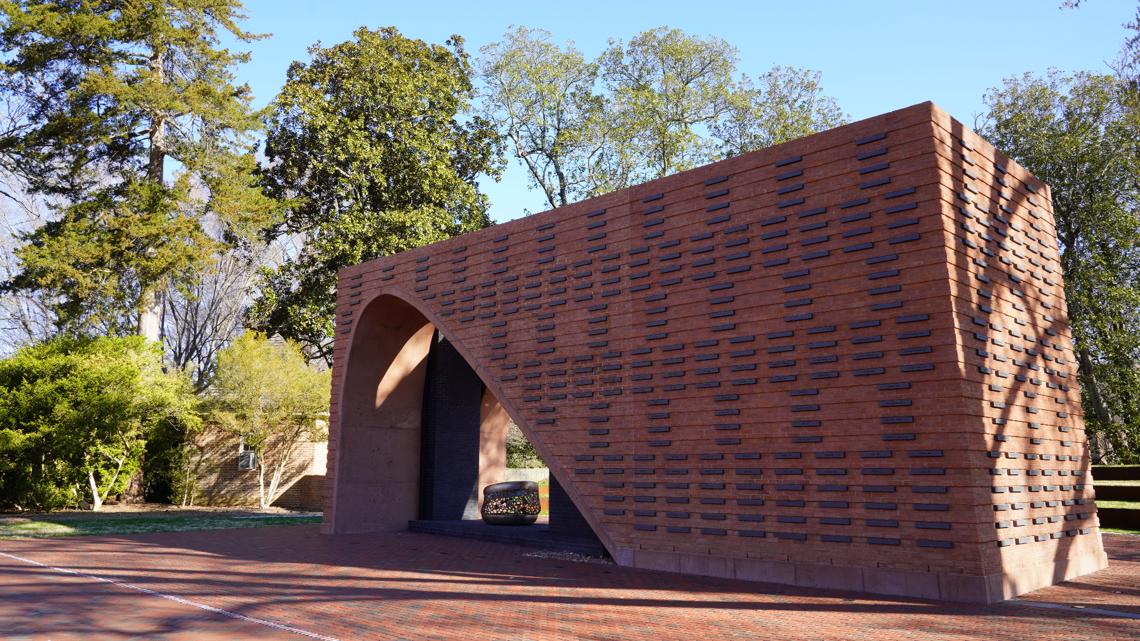
I am glad to say that if you go to the campus today, there is a memorial bearing the names of people who were enslaved by the college over a period of 172 years, some of whom, undoubtedly, built the chapel.
When we consider how getting bigger has been the way of it for America since her beginning, and how the church, for better or worse, has helped her in her quest, it should not surprise us if we, as a church, should feel a certain desire to always be getting bigger as well. I know I feel this way sometimes. As embarrassed as I may be to admit it, on both a personal and professional level, I want bigger crowds, a bigger budget, a bigger safety net. I feel better when people are asking, what can I do? Rather than, do I have to do that again? When my brain is feeling inspired, not empty. When I am not thinking about how to keep something going, because I am too busy trying to keep up. When we, with our ten thousand other things to do, couldn’t be happier to put it all down and show up to church for another Sunday. Yes, I too would like to be bigger.
But who am I kidding? If the article I read recently is any indication, only those churches that are already big are getting bigger, while the little ones are dying. Of course, the article didn’t say what constitutes “big” or “little,” leaving open the possibility, I guess, that 2 people could be considered big, and 2,000 people could be considered small.
What I find interesting is what Jesus says: Do not be afraid, little flock. At the time he said it, Luke records there were thousands in the crowd, so many people that they began trampling on one another.[3] Some were sick, so sick they were dying, and they just wanted to get close enough to have Jesus touch them. Others were lonely and wanted to get close enough to have Jesus hug them. And others just wanted to get close enough just to hear what wisdom or hope he might have to offer. There were thousands of them, and Jesus called them a “little flock.” It’s almost as if Jesus knows, no matter how big we get, we’re still just a little flock.
The truth is, we can super-size our order at the drive-thru all day long and build houses as big as old Solomon had in all his glory, but we’re still going to be found wanting. We can live to see the greatest medical achievements of all time, but there will always be something that can kill us. We can work our fingers to the bone putting food on our table, and even on our neighbor’s table, but the poor we will have with us always. We can be as big as an empire, protected and preserved on all sides, but still, we’ll be a little flock, wishing we could be bigger. So, take heed: do not be afraid, little flock. Do not be afraid for your life, what you will wear, what you will eat. For it is the nations who worry about all these things, and you are not a nation.
If we take Jesus at his word here, it would be easy to take him as reckless. Do not worry about what you will wear or what you will eat. “Man, are you crazy! Everyone needs to eat, and some already haven’t had a bite in days!” But it would be a mistake to take Jesus as saying that in this world possessions do not matter. For what Jesus says is, it is God’s good pleasure to give you a kingdom, and in this kingdom, possessions matter greatly, because in this kingdom people will sell their possessions to provide for the poor. Because in this kingdom, sharing, generosity, and human equality rule. In this kingdom, purses will be stuffed with a kind of riches that will never run out, the riches of brotherhood and sisterhood. In this kingdom, a piece of bread broken and offered in grace will be worth a feast. So, take heed little flock, and do not be afraid, there is a kingdom, God’s own, and it belongs to you.
[1] https://www.npr.org/2023/07/14/1187460517/megachurches-growing-liquid-church
[2] Numbers 13:32; 14:8.
[3] Luke 12:1

 PleaseGrace