Holocaust Remembrance Day

Yesterday was International Holocaust Remembrance Day. I can’t think of many things the whole world stops to remember. A lot of the world marks Christmas and Easter. There are various kinds of national observances. Memorial days; veteran’s days; independence days; thanksgiving days. But there is very little that all of humanity does together. Very little about which we are willing to say, we all had a hand in what happened, and so we all have a hand in remembering, in making sure it doesn’t happen again.

Most of the time we live within our borders, under our individual flags, and according to our passports. Most of the time, we try to avoid being lumped together, so not to appear complicit, let alone responsible, for the disgusting things that go on every day by humanity, against humanity. We are like Adam who, after being found out for eating the forbidden fruit in the garden, pointed at Eve and told God, “She gave it to me.” Ten minutes ago Adam and Eve were both proud residents of Eden, but now that there’s trouble in Eden, Adam must find a way to define himself otherwise. (“Are you a U.S. citizen?” I heard a customs agent ask a man at the airport recently. “I come from Ohio,” the man replied. )

In Adam’s whole world, there are only two human beings. There is him, and there is Eve. Together, they’ve lived like 12 combined days, inhabiting 20 acres, and already Adam is looking to distance himself. And why? Because honesty and humility are painful virtues. It is so much easier to blame the hand that feeds you than it is to admit you knew you shouldn’t have eaten the food in the first place. Honesty and humility are painful precisely because they require us to ask what part we played in turning a world of abundance (“You can eat the fruit of any other tree in the whole garden!” God said) into a world where we see only what we don’t have (“Yes, but don’t you think God would want you to have it all?” Temptation asks).

Apparently not. If the story of Adam and Eve and their expulsion from the Edenic Paradise has any truth to it, let it be this: God does not want, intend, nor allow for us to have it all.

Jesus had another way of putting it. In his first sermon ever preached, he said: “The meek shall inherit the earth.” Given that at that time in history the meek were nowhere near to inheriting the earth, it was a bold promise. And, given the ways the rich and powerful had their hooks into the earth—ravaging its bounty for their tables only, exploiting the labors of the poor, forcing the very ones who depended upon the sustainability and equity of the earth to do the ravaging on their behalf—this promise on the part of Jesus was nothing short of a warning to the rich and powerful. The day is coming when you will no longer be allowed to have it all. The meek shall inherit the earth.

This month alone we have witnessed the tragic and unjust killing, baiting, and snatching of human beings by other human beings on the city streets of Minneapolis. For all the commentary that surrounds these times we live in, on International Holocaust Remembrance Day, let us remember at least this much: from 1933 to 1945 in Nazi Germany it was “illegal” to be anything other than what the Empire allowed. Jews; gypsies; gays; the mentally challenged, all “illegal.” Punishable, it turned out, by death.

For the longest time, much of the world neither looked nor spoke up. Not when they heard the steel wheels of the train slow down for Auschwitz, not when they saw the smoke rising from the chimneys. Even the Christian Church looked away in silence; German ones, and American ones too. Among those who did take notice—who gave hiding to the “illegals,” who refused to believe that real power exists in the threat of fear and the use of force by politicians, and who stood up and spoke out to say so—they too were branded “illegal.” Many were hung or shot for their “crimes.”

81 years later, we must not be silent again.

For if being human were not enough to require us to condemn the use of violence by any government against any people, there are those who call themselves Christian, who draw both their faith and living from a man who was a Jew, arrested, beaten, and killed by the Empire for activities deemed illegal. For believing the meek really shall inherit the earth, and then behaving accordingly, Jesus died.

I find a certain hope, though, in knowing that 2,000 years later there are people in churches and on the streets who are still crazy enough to say out loud, “The meek shall inherit the earth.” Just as I take hope in seeing that, 81 years later, Holocaust Remembrance Day is international. Honored now not only by countries who perpetrated the horrors of holocaust, or suffered its horrors, or liberated its victims, or stood by in disbelief, indifference, or vain ignorance of what was happening, but also by countries who recognize that just being on the map obligates us. We all share a common fate, and so we owe it to each other to say, never again, and to work for that day when the promise of the meek shall be fulfilled.

Paul Revere’s Horse

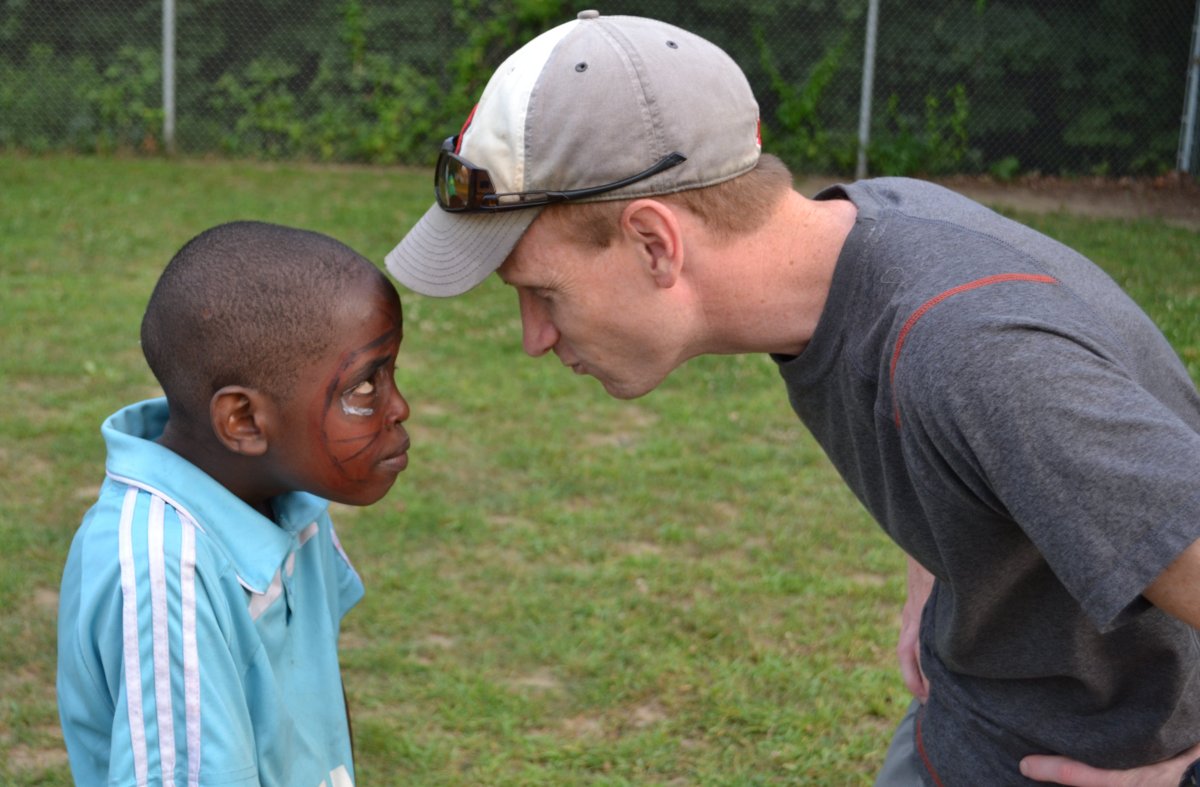
Back in 2017, I traveled with one other adult and four middle school students from my church to Lewiston, Maine.  I had only one purpose in mind: to meet the community of Somali refugees who now called that place home.  

My church, located in Rhode Island, was, and still is, only 180 miles from Lewiston.  Is that too far away to call the people living there our neighbors?  I was as unapologetic then as I am today in saying, it is not.  My neighbor is whoever I treat like a neighbor.  Whether they like my cookies, lawn sign, or family does not matter.  

In 2017, I was not a new pastor.  I had been breaking bread, pouring water, and proclaiming good news for 9 years already.  But I was a new pastor to my church.  I knew I could probably gain more popularity with the teenagers there, and keep them coming around longer, if I took them to Six Flags or the beach.  But I didn’t want to.  I wanted to go meet my Somali neighbors in Lewiston.  I wanted to hear the story of how they came to be in my country, because I was as convinced then as I am now that this country isn’t mine, at least not any more than it is theirs.  Whatever their arrival story was, I knew my ancestors had one as well.  We all do.  And I knew then, as I know now, that my great-great grandparents landed on these American shores with a lot more pomp and circumstances than the Somalis in Lewiston did.  With a goodly amount to give, a lot of take, and not nearly enough asking.  With a lot more manifest destiny than would ever fit inside a sambusa.  So, I wanted to hear how far it was to Somalia, and how many boats they took, and how many checkpoints they crossed, and how many times they lost their family only to find them again, and how do you keep hope alive for that long?  I wanted to hear about their longing for home, and their longing to return home.  And most of all, I wanted the teenagers in my church to hear all this as well.  I wanted them to go to Lewiston, to eat sambusa, to wonder at the sound of the muezzin and marvel at the commitment of a people who have been stripped and scorned to stop on a dime and still pray prayers of gratitude to their God five times a day.  I wanted their young 13 year old hearts to be stretched by a single question: is it enough to be human?  

Is it enough to know that the same air which blows across the Somali desert, breezily lifting the wafting smell of sambusa there, is the same air that catches the wing of a seagull off the Arabian Sea?  Lands it on the rail of a cargo ship stockpiling Toyota parts, and then carries it across the Seven Seas to the rocky New England coast smelling of pine and…sambusa.  

Is it enough to know that no single vision for the world—not John Wayne’s, not MLK’s, not Sister Teresa’s, not even Jesus’s—can absolve anyone of the possibility of terminal cancer and the desire to understand why bad things happen to every sort of person?

Is it enough to know that in the spring, when the cherry trees have begun to blossom in the square, you can walk the Freedom Trail of Boston and pass through “Little Italy?”  There are no meat packers unloading crates down by the docks anymore, and the light in the steeple of the Old North Church has long burned out, but in a brick deli on Hanover Street, Guiseppe can still make a sandwich the way his mother did in Sicily.  “Can you believe it?  If Paul Revere were around today, even his horse would want to eat Italian!”   

Is it enough to know that no baby asks to be born, just as no baby knows where it is being born?  Only a mother knows, and every mother worries for the safety and whereabouts of the next meal for her children.  

Is it enough to know that when I was five, I, like Liam Ramos, was baited? Not by ICE but by three other hoodlums in a Pontiac offering candy.  I didn’t take the bait.  I wanted to.  They had candy for god’s sake!  But those were the days when a child could call out for their parent from the porch and, even if your daddy’s skin was brown, when he appeared, it was enough to make hoodlums drive away.  Now, both your skin and your daddy’s skin must be white.  A shade recognizably hailing not from a “hellhole country like Afghanistan but from a nice place like Denmark,” is all the President asks.  (Don’t take the bait, Denmark.  It’s just an old trick we play on the natives.  Turns out, we don’t want you, either.  Just your land.). Otherwise, both you and your daddy are going to get snatched up and thrown into a backseat where you’ll have to work overtime to remember you’re not the hoodlum.  

Is it enough to know that I am a father too, and all I want for my children is the same fate Liam’s father wants for his boy?  To be caught, yes, at the U.S. border, but to be told by the agent, go back home to Lewiston.  We enforce customs and it is our custom to protect the vulnerable.  

Is it enough to be human?

I went to Lewiston believing the answer was yes.  I listened for the call of the muezzin, I gave my lap as an altar for Somalia’s children to lie down upon, I ate every sambusa offered to me, found I was satisfied, and got my answer.  

But as U.S. federal agents descend upon Lewiston today, targeting some 1,500 persons of Somali refugee and immigrant status—barking deportation, stoking fear, pretending power, getting off on cruelty—I fear they are not waiting for an answer to this question.  I fear they are not even asking this question.  So we must ask it for them.  We must insist that one cannot be American, let alone make America great, if we ourselves don’t even care about being human.     

I have hope, though, that 250 years from now someone from Lewiston will be walking around their city and, going straight into a bakery, a man named Hassan will feed them on sambusa and a joke about Paul Revere’s horse.