A Light to See Better By

A couple weeks ago I went to see the eye doctor.  No pun intended.  The last time I went to the eye doctor was about four years ago.  That was also the first time I went to the eye doctor.  You heard that right.  At 41 years old, I had never gone to the eye doctor.  I guess I thought that if Mary could get pregnant and deliver a baby without ever going to an OBGYN, then I could go 41 years without seeing the eye doctor. 

Of course, I’d had my eyes checked many times before.  When I was a kid, they got checked every fall by the school nurse and then again in the spring by Dr. Killion, my pediatrician.  Given that I’d never worn glasses or contacts in my life, I assume I checked out each year.  That I was able to read all the way down to the seventh or eighth line on the eye test chart with no trouble.  But a couple years ago, I noticed the letters on the page of a book were getting a bit blurry.  Driving didn’t seem to be a problem, but reading was.  So, I went to see the eye doctor, who sent me to CVS to buy a pair of reading glasses off the rack.  “You don’t need anything more at this time,” he told me. 

Then, this fall, I noticed my eyes were feeling the way my legs sometimes do after I’ve been home sick on the couch for a couple days.  Achy.  Heavy.  Like they’re trudging through a dense fog and I don’t know if I can trust them.  Except I hadn’t been sick, and my eyes still felt that way.  I was noticing that they sometimes felt that way even after a good night’s sleep.  After being closed for eight hours straight, they still opened tired. 

So, I went back to the eye doctor.  He did a standard check-up, nothing fancy.  Turns out, I probably could stand to wear glasses all the time now.  But still, “Your overall eyesight is very good,” he reported.  “Why, then, do my eyes feel so tired all the time?” I asked.  “Probably because you’re seeing too much,” he told me.  “Seeing too much.  What do you mean I’m ‘seeing too much?’”  I was feeling a bit defensive.  “I only see what I have to to get through the day.”  “Do you?” he said.  I thought his tone was a little snarky and I let him know by giving him the silent treatment.  “I mean, David, think about how much you’re probably seeing every day.” 

I thought about the more than 50 promotional emails that I’ve been seeing hit my inbox every 30 minutes since Black Friday, and how quickly I scroll through them just to delete them.  I thought about how I don’t watch TV news anymore, but most nights, after I hop in bed and shut off the light, I still check the daily headlines on my phone. Swiping up and down, left to right across the screen.  How quickly the whole world comes to hop in bed with me all at once.  And why do I do this at 10 p.m.?  Did I really just shut the light off only to now turn another light on?  If I happen to read that another 100 children died of famine today in Gaza, am I going to hop out of bed and go to the grocery store to put together a care package for tomorrow’s 100 children?  Probably not.  I thought about how, just ten minutes ago, I was sitting in the waiting room.  “The doctor will be right with you,” the receptionist assured me.  The music playing overheard was lovely, an orchestra covering The First Noel.  I felt my body relax as it slumped into a chair.  So, what did I do next?  I told the receptionist I was going to step back outside for a minute to check my phone and see if I had any voicemail messages.  Standing on the curb, my eyes couldn’t avoid the sight of two cars stopped in the middle of the road.  There hadn’t been an accident, but the two drivers, jawing out their windows at each other about who was riding whose tail, were definitely in a collision.  My relaxed body was feeling like it needed to be taken home and put to bed.  Which I might have done if I thought I could trust myself to just turn off the light and not check the daily headlines. 

So, maybe the good doctor is right, maybe I have been seeing too much.

But here’s the thing: I’m not sure he, or anyone else, could convince me to see less.  Because what I want, of course—what I think we all want, and need—is not to see less, but to see better.  On this Christmas night, when we proclaim the birth of the One who was called the Light of the World, we can hardly ask to see less.  For Christmas comes bearing light.  Light in the darkness.  Light that no darkness, says the Gospel, can put out or keep out. 

In this way, Christmas comes as both good news and terrifying news.   Terrifying to anyone who might prefer to keep things, people, or themselves, in the dark.  The dark can be very useful and productive space for getting things done, especially if you are the only one who knows your way around in it.  Meanwhile, everyone else is left to wonder, and worry, at what you’re up to, what you might do to them, and will you ever turn the lights back on.

Darkness was the weapon Caesar Augustus and Quirinius used when they ordered everyone, including Mary and Joseph, to return to the places they had come from.  You can no longer live here.  You must get out.  No, it does not matter that this is your home or that you don’t have a home to go to.  Nor does it matter that you are nine months pregnant and life is already full of hardship and uncertainty for you.  Get out.  I will not be your neighbor, and you will not be mine. 

Joseph and Mary had to go to one of the most pitiful spots on the map, Bethlehem, where, as history records, there was no room in the inn.  But look out!  For Luke says she and Joseph arrived there and no sooner was it time for Mary to deliver her baby.  She had traveled long enough in the dark shadows of the powerful.  Now the powerful would be overtaken by a poor woman and her baby filling that darkness with the gentle light of courage, hope, and life. 

When news of the birth of Jesus reached Caesar and Quirinius, it must have terrified them.  Made them see that you can fill the whole world with darkness, but all it takes is a tiny, flicker of light to send the darkness running.

My friend, Jenny, says, The Christmas story shows us the worst of times and in so doing, shows us that God’s response to the worst of times is to say, Things don’t have to be the way they are.

The Christmas story, the story of Jesus Christ here among us, reminds us that we do not belong to Caesar or Quirinius, or to their darkness.  We belong to God who is Light that cannot be put out or kept out.  Remembering to whom we belong is a threat to those who really want us to believe that they are in charge, that they are the ones who hold the power.  But they aren’t.  They never have been.  And they never will be.[1] 

For tonight we dare to proclaim that Jesus, the one born to Mary and Joseph, placed in a manger, coming in darkness, is now, has been, and ever will be God of Glory, Friend to the Poor, Healer of the Brokenhearted, Light of the World, Emmanuel, God-With-Us, bending low to be among us.  See him now.  And have a very Merry Christmas.    


[1] Rev. Jenny McDevitt, from her sermon, “What Christmas Means to Quirinius: Threat,” preached at Shandon, Presbyterian Church, 12/16/25.

What Do the Blind Know of the Light?


What do the blind know of the light?
Whole days, every day spent in darkness.
The sight of their hand known only
by the way the elbow bends in, the arm turns up,
fingers stretch open, peel, release from clutch,
until the palm lays flat like a map,
every line a river, the edge of a hillside
in a country that bears their name,
the smell of all the day has touched
wafting forth like a vision of things adored.
The soap in the shower, the fresh cut mint sprig,
lovingly retrieved from May’s garden,
the splash of coffee from the mug
catching the edge of the counter,
the talcum powder smeared upon the baby’s bottom,
the residue of sweat, now dried and cold from
prayers made, answered, or left on hold for another day.
If you never saw a day in your life,
but I told you my name is Light,
and we spent all our moments in friendship,
would you cover your eyes from the brilliance?
Would you never count the seconds of sunlight that remain?
Would you take my hand, turn me to your face,
tell me I’ve never looked so good,
and smile at the sight of it?

Salvaging the Heart

We lost two more children this week, God.
And that’s the awful truth.
We lost them.
At 3 p.m. on Tuesday we knew where
they should have been.
Kicking a rubber ball over second base,
loitering in front of 7-Eleven,
taking up a collection among buddies
to afford a bag of chips,
scarfing down said chips.

We called their grandparents.
Maybe they’d gone there on their bikes.
But there were no skid marks in the driveway.
We opened their bedroom doors and
hollered their names.
No one called back, Here, Mom!

We lost them.

Their bodies we found in church,
10 feet back and 6 feet under
from where Jesus also lay dead.
After all these years you can still see Mary,
stone faced, keeled over at the foot of the cross,
looking up at her son like she refuses to
understand what he’s doing up there.
The Bush-league killed him.
(More awful truth.)
The government said they knew he was innocent
but it would be more convenient this way.
It’s a mob out there. Plus, you know,
right to assemble, right to bear arms.
Better to sacrifice one from across the river
than to piss off the natives.

I went to the Church of The Natives up the road to inquire.
I asked to see where the little Lord Jesus
laid down his sweet head.
They said, this is the Church of the Nativity.
He was only born here, he’s not from here.

No wonder we lose so many children.

Native. Nativity. Birth. Birthright.
A couple more or few-- letters so we can say
you’re not my problem.
I hope I’m never lost without food, money, or I.D. in Turkey.
No one will know they won’t die if they feed me.

On Sundays where I come from the priest
tries to tell us his body was broken for us
so that we could be whole or something.
But I’m starting to think that’s a lie.
We broke Jesus, and then we lost the pieces.

Not all of them, mind you.
We scrapped and sold what we could
to the highest corporate bidder.
Took the money and bought ourselves a
first-class ticket to Eden.
But the sign upon arrival said,
No Re-Entry.

Because we lost them.

Christ. Mary isn’t going to go
to Egypt without Jesus. Eve ain’t
returning to Eden without Cain,
and Abel too.
Home is where we learn to break safely
and be lost.
Until we find all the pieces, though,
home just won’t be home.
Mothers say so.

So, light the lamps,
release the hounds,
row across the Nile.
There are no shorelines tonight,
all waters are international.
The mission is to salvage
the heart.

.25 Cent World

One morning this past week I was at the gym.  Part of a strip mall, there’s a supermarket at one end, a hair salon at the other, and in between a dialysis center, a laundromat, a pizza place (take-out only), and my gym.  One of the embarrassing but marketable features of a strip-mall gym is the row of windows fanning the entire front wall, giving everyone passing by on the outside a full view of what is going on inside.  So, when I’m straining to lift a 15 lb. dumbbell, the guy who is dropping his dirty underwear on his way across the parking lot can see me, and I can see him.

Anyway, one morning this past week I was in the gym, waking my legs up by riding on one of the stationary bikes.  Beside me was my friend, Amy.  Outside the window we could see a woman making her way across the parking lot.  Judging by her appearance, she was elderly.  Her hair was silvered, her walk, slow and stilted.  Rounding out at less than 5 feet, she reminded me of my late grandmother.  In her hand, I could see that she was carrying something, and whatever it was, it had her full attention.  Amy and I figured she had to be heading towards the hair salon, but as she got closer and closer to the building, she seemed to be getting closer and closer to us.  Then, sure enough, she walked into the gym. 

Being closest to the door, I said, “Hi.  Can I help you?”  That’s when she showed me what was in her hand—an iPhone.  To be exact, it was a newer model iPhone than my own.  Not that I was jealous.  Most days I would gladly send my phone down river in return for some good old-fashioned human-to-human contact.  I was more confused, because it was clear she didn’t know the first thing about how to work an iPhone.  “My daughter bought this for me.  She says they call it a smartphone, but it seems pretty dumb to me.  I’m trying to get it to tell me how to get somewhere.”  “Where are you trying to get to?”  I was near certain that wherever it was, it wasn’t the gym.  “To my doctor’s office for an appointment.” 

It was in that moment that I detected an accent.  I’m no expert, but it sounded non-British European to me.  I don’t know why I hadn’t noticed it before, because when I was a kid, my grandmother, the same one who rounded out at less than 5 feet high, had a best friend named Anne.  Anne lived three doors down from my grandmother and they did everything together.  Church, grocery shopping, Tuesday morning knitting club, Friday evening card playing.  They even went on vacations together, only sometimes to take along their husbands.  Though Anne wasn’t family, we all called her Aunt Anne, and she too had an accent, the same sounding one as the woman now standing before me in the gym.  I knew Anne’s accent as belonging to a woman who, as a very young girl, had been sent by her parents from France, with her three sisters, to go live in the United States, far away from the occupying threat of Hitler and the Nazis.  This was a story Anne not only never shied away from telling but was bold to tell, making sure everyone, and especially all us kids, understood that, though she came to the U.S. in 1940 under immigrant status, had the U.S. not been an ally in the Great War, she would have been considered a refugee instead.  “We don’t always get to decide what we are.  Most of the time, other people are going to decide for us,” she would say.  “Remember this, because you live in a part of the world where you are probably going to get to decide for others.” 

I did not ask the woman with her iPhone 17 where she had gotten her accent, though I did wonder how far she had come to get to where she was.  I don’t mean to the gym.  I mean how far she had come to now be standing there with me in the town she calls home, but still not be able to find her way to her doctor’s.  I wondered if she had had to flee her country once upon a time.  Was she a refugee, an immigrant, a legal?  What had to happen for a woman, any woman, to wind up in a place where she must pull into a strip mall and ask a stranger for directions?  Did her daughter know where her mother was?  Lost.  In that moment a certain irony came to me.  This woman, who was trying to get someplace, and might already have been there if not for her dumb smartphone, was clearly no stranger to finding her way in this world.  Meanwhile, the speedometer on my stationary bike said I had already gone 1.2 miles, yet I hadn’t moved an inch.

“Where is your doctor’s office located?” I asked her.  “At the football field.”  “You mean Gillette Stadium, where the Patriots play?”  I figured she was looking for Brigham and Women’s located right next door.

“How about I take a look at your phone for you?  Maybe I can figure out why it’s being so dumb.”  Handing it to me, I couldn’t help but notice the face of an old man staring back at me on her home screen.  His thin gray hair, combed across his balding head, looked crisp and chiseled.  His closed smile gave off a contented, restful look.  “That’s a very nice picture,” I said. “Yes, it is,” was all she said.  I assume it was her husband, her late husband. 

Her phone told me that it had no internet access.  “I think I see the problem.”  “Can you fix it?”  “I’m sure I can.”  I fiddled with her maps app, I even powered the whole thing off and then back on again, but 5 minutes later, I was sure all I had done was to accidentally connect it to a satellite somewhere over Australia.  “I’m sorry, I don’t seem to know how to fix your phone after all.”  “So you can’t make it talk to me?”  “No, but I can do my best to talk you through how to get to your doctor’s office.”

In hindsight, I don’t know why I didn’t offer to just go with her, or at least have her follow me there in my car.  Actually, I do know.  I had other plans in mind for myself.  I had come to the gym to work out, and a short 1.2 miles on a stationary bike wasn’t how I wanted to leave things.  Plus, she seemed agreeable to my proposal. 

“Do you, by chance, know how to get to the highway from here?”  “I know how to get to Route 495. Does that help?”  “Yes, it does!” I was feeling like I’d soon be able to get back to doing what I’d come to do.  “If you can get to 495, drive north on it.  Then, take the exit for Route 1 North.  Look for Gillette Stadium and you’ll find your doctor’s office.”  I looked down at my feet, suddenly aware that, no longer was I not only not on the stationary bike, but the whole time I had been talking with her, I had backed myself half-way across the room from her.  And I was still moving.  My mind was definitely elsewhere.

Mercifully, the woman was much kinder than me.  “You have been so helpful to me.  I’d really like to give you some compensation.”  Embarrassed, I stepped quickly back in her direction.  “No, no.  That is not necessary.  I didn’t do anything.  You came in asking for help with your phone and I couldn’t help you at all.” 

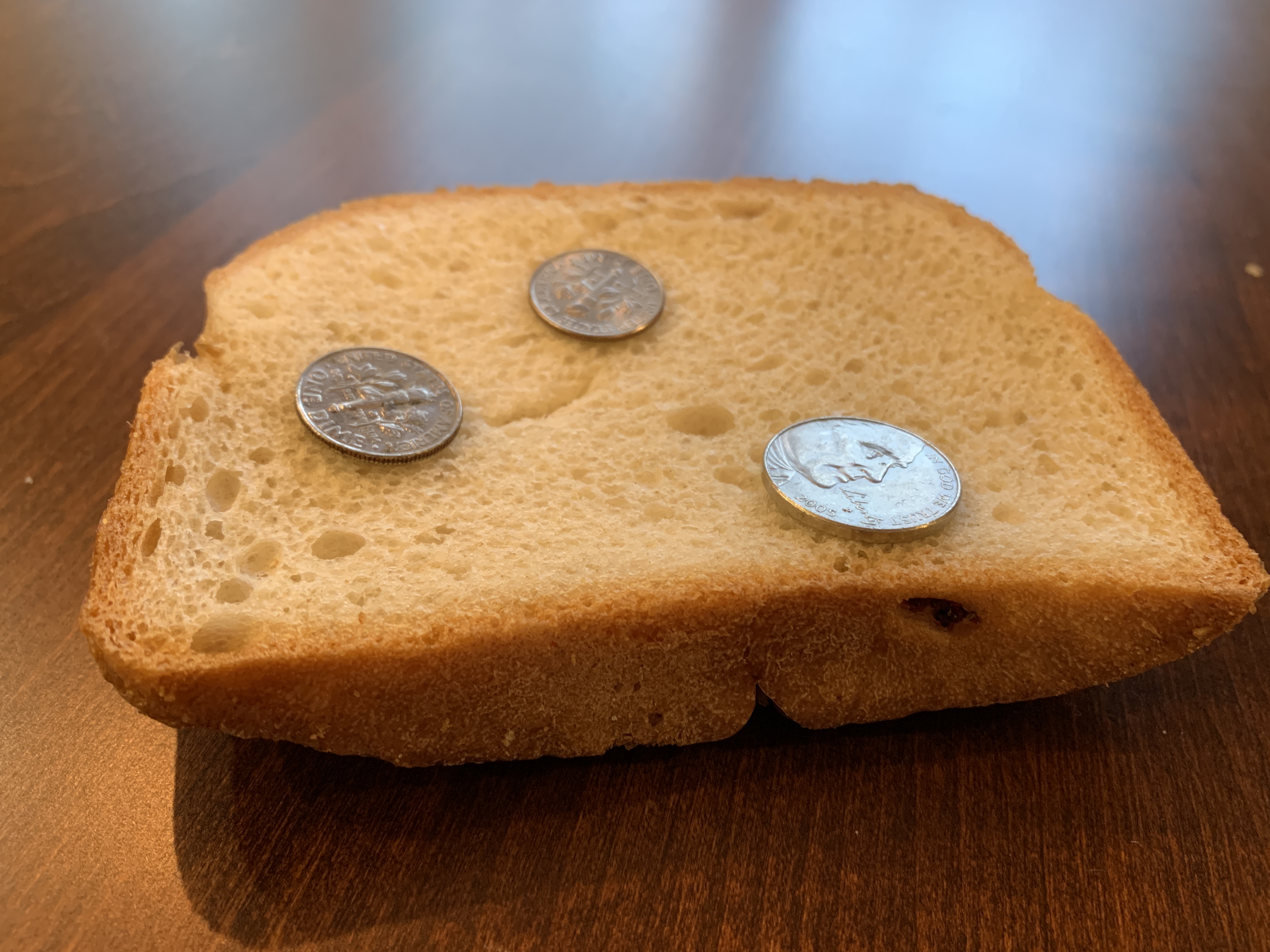
She looked away, her eyes got a thoughtful look to them.  I walked her to the door and out onto the sidewalk. “I really want to give you something for your help today.”  Taking my hand, she peeled open my fingers and proudly dropped something into my palm.   I looked down to see two dimes and a nickel.  .25 cents.  “Thank you,” she said.  “When I asked for help next door, no one even tried.”

A couple doors down, a delivery man was dropping off bread. In big red letters on the side of his truck was painted the word, WONDER. I thought about how, for what I had in my hand, the man probably wouldn’t have sold me even a slice. Not one single slice. I wondered if he knew how rich I really was.

A Prayer on the Eve of Hunger, that all may be full tomorrow

O God, our lives are made 
of such little bits of bread. 
The prayers we offer appear
as crumbs in the face of a world
starving from indifference
and too little mercy.  And our hands,
busied by the clock,
feel heavy from churning emptiness. 

We want our living to be
more than a feast on our own table,
while scraps clog the drain in the sink,
(and still our own cup overflows!)

The squirrel searches the same earth every day
for browny crowned treasures, and finds them.
The geese fly miles in one direction each November,
and always land at home.
Meanwhile, the bear sleeps winter away with
no thought of honey or salmon, trusting
spring will set the table and ring the breakfast bell
once again.

O God, we confess,
our problem is not that we possess only crumbs,
but that we might not care to share even our crumbs.
Or we do not see what the dogs see.
While someone else sweeps the floor for us.

You who broke bread and called it your own body,
break us open today, and then break us again,
until we are like crumbs—
leftovers of joyful discovery,
bits of grace for the poor
and all who thought there would be no love left for them. 

This we pray for the sake of the child who grew to become
abundant Bread of Life, crying out,
I thirst, Amen.   

Dad By The Numbers. In Memoriam.

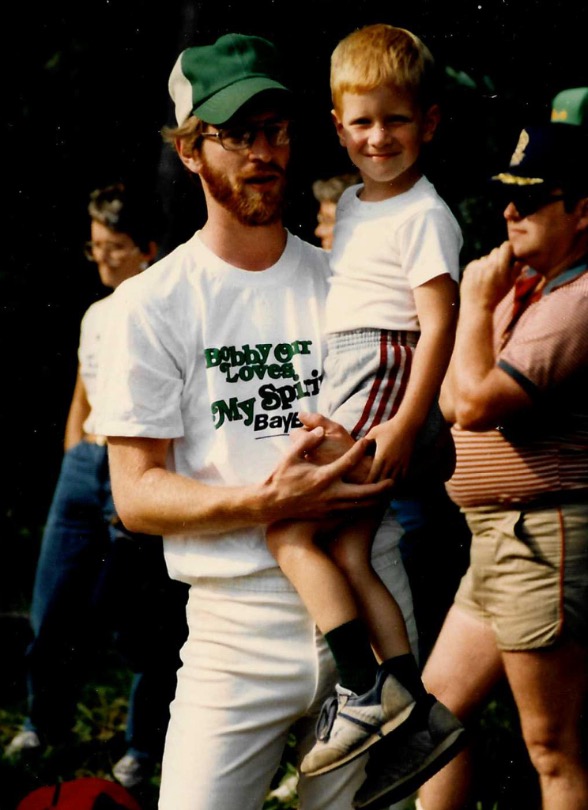
There are many things I am proud to say I have in common with my dad.  We both relished the way a baseball feels in the palm of your hand.  Two fingers stretched across the red stitching, the windup, the release, the whizz of a fastball, the popping sound it makes when leather hits leather.   We both have a bit of red, and we both have less of it now.  I wear mine on the top of my head.  Dad wore his as whiskers to his beard.  We both loved sitting down to noodle at the piano at the end of the day.  Simon and Garfunkel, Showtunes, Disney ballads.  If Dad hit a wrong note, he could cover it up with his singing, which was always right on key.  I, on the other hand, must suffer the sound of my bad notes. 

But an understanding of and proficiency with numbers, I do not have.  Every year when it came time to do my taxes, I called Dad to check my work.  One year he said, “Why don’t you use TurboTax?”  The next year I called him again.  “I thought you were going to use TurboTax.”  To which I said, “I did.”    

Anyway, keep in mind that Dad is not here to check my work as I now proceed to do the numbers.

20.  That’s how old my dad was when I was born.  Not even a whole year yet past being a teenager. 

50.  That’s the amount of dollars I’m guessing he was worth at the time.  My mom told me once that the reason they decided to have me when they were still so young and penniless was because they wanted Jonathan to have someone to grow up with.  A playmate, a brother, a sidekick.  It was Dad, though, who told me they had me because they liked having Jonathan so much and simply wanted another. 

2.  That’s the number of miles my dad moved between houses in his lifetime.  Well, that’s not entirely true.  From Fort Dix, New Jersey to Schaumburg, Illinois it’s 822 miles.  From Schaumburg, Illinois to Mansfield, Massachusetts it’s 1,000 miles.  But all that happened before my dad was even 8.  10 years later, when Dad was 18 and he moved from 497 Williams Street to 100 Gilbert Street, he moved his bed 1 mile.  When, at 30 years old my parents built us a home at 386 Gilbert Street, that distance was also just 1 mile.  Are you checking my work?  1 mile plus 1 mile equals 2 miles.  My point is this: growing up in a big family alongside 5 brothers and sisters, Dad never got to travel much farther than to the baseball fields in town on his bike.  That he and Mom were able to take Jonathan and I to Prince Edward Island, Sedona, Glacier Park, Hawaii, and Swanzey Campgroud (just to name a few of Dad’s favorites), and then later to travel all over Europe with Mom, is something Dad never took for granted.  But most of all, he never took living close to family for granted.  His favorite distances to travel were any that led him back home to his people, and especially to Sharon, Attleboro, and anywhere he could hear someone call him Papa. 

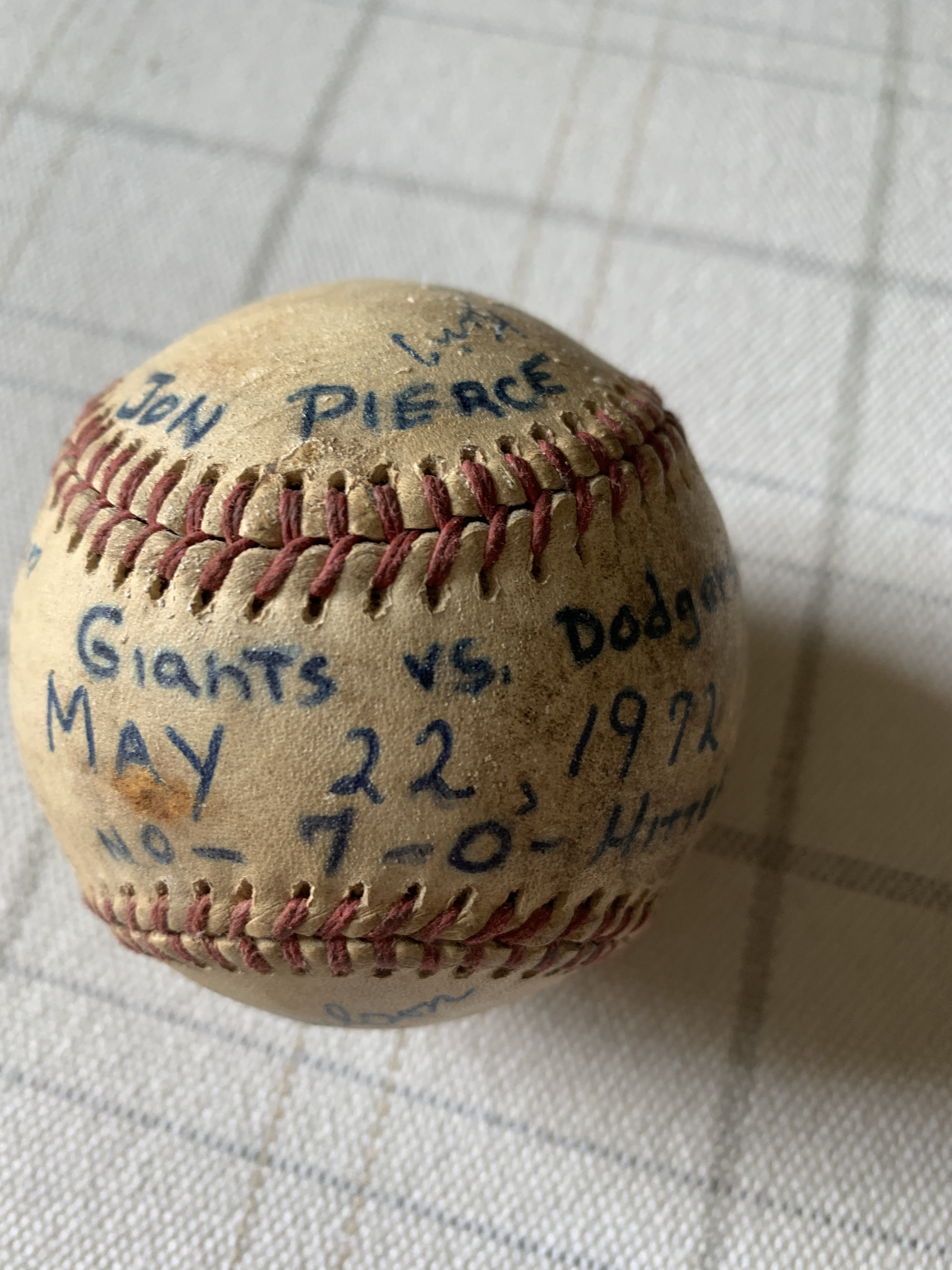
7.  That’s the number of runs his little league team, The Giants, scored against the Dodgers on May 22, 1972.  Dad pitched a no hitter that day, striking out every batter in the game but one, who on the last pitch of the game from Dad hit a pop-fly that got caught by—you guessed it—the pitcher.  Dad kept the game ball from that day, along with 5 or 6 other balls from his years playing little league.  I found them in a box down in the basement last week.  On each one he wrote an epitaph to whatever poor opponent he took down that day.     

80.  That’s how fast Dad’s fastball felt coming at my head when he was still only 29 and I was 9.  He wanted to show me that the harder you throw the baseball the more accurate you will be.  I thought he was going to give me the ball and say, now throw it as hard as you can.  Instead, he told me to sit down on second base.  Not around second base, but on second base.  I crouched down.  “No, sit on your butt.”  I did.  Did you know that when you’re on your butt, you can’t get out of the way of flying objects very quickly?  Dad stood on home plate and hummed the ball at my head.  I’d like to tell you that’s the day I learned to throw a baseball hard, but it’s not.  It was the day Dad helped me to see I could do hard things.  It was also the day I realized that even if I wasn’t as good a ballplayer as some of the other boys, my dad could show up their dads any day.

39.  That’s how old Dad was when he got his first big break in banking.  Having worked 21 years already as a teller, branch manager, and treasurer, with nothing but a high school diploma under his belt, he got to the top rung as president.  Mind you, Dad never put it that way, because Dad never really talked about it.  If you asked him what he did for a living, he’d say he was married to Martha, was a dad, a Papa, and loved to mow the lawn.  If you pressed him on what he did for a career, he’d tell you plainly, I’m in banking.  But if you really pressed him, he’d tell you he was a bank president.  For being a bit temperamental in his younger years, Dad turned out to be very patient and steadfast.  I loved telling people this about him, about how hard he worked to become a president.  Still, if you asked him, he’d tell you he didn’t always do everything right.  He was honest to admit that, like all of us, he could have done better by people at times, and that he reached the top rung only because others turned around and, with grace and kindness, pulled him up.  Which is something we all should do every day for one another.          

31.  That’s the number of days since Dad last did what may have been one of his favorite things to do in life: pick up the check at a restaurant.  For whatever Dad didn’t ask for in this world, calling up his two sons to ask us if we’d pick him up to go out for coffee or dinner in his last days was never a problem for him.  A few weeks ago, he said he wanted to go to Fresh Catch.  Walking had become a bear for him at that point, and he also didn’t seem to have much of an appetite, but he hobbled his way in and to a table where he feasted on sushi and oysters.  We made him promise he wouldn’t throw up on mom in the middle of the night.  When it came time to pay the bill, he pulled out the only thing he had in his pocket, his debit card.  “I thought you didn’t have that,” I said.  Mom had discovered a fraudulent charge on her card a few days earlier and had been using Dad’s ever since, giving us, we thought, the perfect excuse to pick up the check for once.  “I made sure to get it from Mom before we left the house,” he told us.  Of course he did.  That was Dad.  He knew that good food makes for a good table makes for good friends, but first we must be generous.   

And finally, but certainly not least, 65.  That’s the number of years Dad grew to be upon this earth.  In our grief and longing, I have heard some call it a small number, a too small number.  But when I think of life and love—what one makes of it and what remains of it—I can only think to call it what I believe Dad would have called it, and would call it even now: a good, complete number. 

Rest easy, Dad. You pitched a pretty perfect game.

Quimby

I.
When the teenage boy down the hall would
leave his dirty laundry on the floor, I’d get on him about it.
You would just go and get on the laundry.
Underwear. Black socks. Gray sweatpants—
100% cotton, made to keep a person warm in winter.
Heavy between your teeth, one leg turned inside-out,
your own legs trying to keep from slipping
as you dragged them out into the open,
all the way into the backyard if no one was looking.
One time you went over and stole a shirt from the neighbor.
Whose is this? I asked the next laundry day.
(Bark) Mine. (Bark, Bark) Mine and Jean’s.

Why do humans wear perfume and
burn candles to cover up their own smells?

There’s dirty laundry on the floor again.
I miss you showing me how to use it for a pillow.
Pleasant dreams.

II.
Every night, you would lay at our feet in the living room,
between the couch and coffee table. 
When we’d get up to go to bed,
you’d already be gone to the world. 
We’d shut the lights off and climb under the covers. 
10 minutes later, we’d hear you saunter through the door.
You knew your favorite side of the bed. Same as me. Her side.
There, your paws would slip out from beneath you,
as the last thing I’d hear, before a contented sigh,
was the thump of your soft belly hitting the floor. 

I still miss that sound.

III.
It’s raining outside.
I guess I don’t need to go after all.

You can go back inside.
I want to stay here and watch it till it stops.

You think I sleep all day while you’re at work.
I’m also just waiting for you to come home.

I don’t mind the rain or you being gone.
I love thinking about what’s going to happen next
anytime a door opens.

IV.
The vet said there was nothing more they could do.
Turned out, that wasn’t true.
When she came back into the room, she brought a syringe,
a sedative, and a whole bag of treats. Unopened!
Take as much time as you need.

I gave you one treat, then two, then three.
You seemed fine, perfectly fine to me.
Then I remembered what we’d come for,
what we’ve all come for.
We’ve had all the time we need.

Within ten minutes you were in my lap,
the bag of treats completely empty beside us.
On any other day, a gift of that size might have killed you,
which would have killed me.
But today it was all the time we needed to find us a rainbow.

What is dying but the thing we get to do for having lived.
And what is losing but a doorway through which more can now enter.
And what is a dog but a friend who will give us
all the time we need to learn how sweet life is, unendingly so,
when masters finally become students.

Cancer, hatred, sorrow, war.
They say there are things for which there are no cures.
But all that means is we don’t all get to live as long as we want to
(while some live longer than they know how to)
But I say where there is caring there is hope without end.

Jokers

How big the head,
needy the mind,
small the heart
from fear,
that demands to hear
thank you.

Oh dear [one],
How hard for us to see,
we have no cards left to play.
They have all been turned
face-up on the table…
all jokers.

Maybe someday we will
care enough to ask how it feels
to play with no hand at all.
Maybe someday we will
see how much we lost
that day we [said we] won.

Catch and Release

let us say that today 
we will play this game by a different way
and not call it a game at all
but calling it by its true
much more needed name
we will catch
children in our arms...
the poor from falling through cracks...
widows in their grief...
the displaced and terrified in our sanctuaries
we will rise early to catch the sunrise,
remembering once more this day,
gift, all gift, not from Caesar but of a gracious hand
we will catch up with old friends
left out in the fields past suppertime,
and we will listen with ears like hearts,
catching second and third chances,
and joy, we will give up hiding,
we can wait no longer to hear you squeal,
caught you!
as we rise from our coffined corners
just in time to catch a shooting star in both eyes
and the bits of crumbs that fall from our tables
like hope each day,
will be caught and gathered and baked into bread
to be placed on altar doorsteps
and we will say we remember when
the world wasn't flat and
horizon lines and spits of land were just another place
to catch anchor and call home
as we learn to release ourselves gently
without ripping
from the people and things that have hooked us
for death in this world.

A Bigger Heart and Smaller Head for the Old Colossus

I'm trying to square something.
A headline from out of the Big Apple
says the President may cut aid
to Jordan and Egypt
if they do not accept displaced Gazans.
Sounds to me like the President expects
those people over there to be good neighbors.

Meanwhile, here at home, the President
says we the United States of America
will no longer make room for the displaced.
Take your tired, poor, huddled masses
yearning to breathe free,
the wretched refuse of your teeming shore,
and go back to where you came from.

(Unless you came from Gaza,
then go to Jordan or Egypt.
Having financed your destruction,
we will now roll the dice and
win ourselves a fortune
where you once fed your goats
in the morning sun)

This is the Golden Age of America,
we lift our lamp and
proclaim you will do what we say,
not like we do.

How big has our own head become.
I fear that soon it will be so big
we will be

displaced.

(Who, then, will take us in?)

Maybe Emma Lazarus will rise from her grave,
lead us back down to the shore.
Maybe our oars will still be there,
dried and cracked from years of forgetful living on land
but still intact
we will board our ships and shove off,
if only to return and remember our own great need
for home and country.